A parking lot can feel normal right up until it does not. If someone is following too closely, approaching your car, or making you uneasy on a trail, your first need may be to create attention fast. The personal alarm versus whistle decision comes down to one question: which tool can you activate quickly enough to call for help and discourage unwanted behavior?
Both are nonviolent, legal in many places, affordable, and easy to carry. Neither replaces awareness, a safety plan, or calling 911 when there is immediate danger. But either can be a meaningful layer in your everyday carry if you choose the one you will actually keep accessible and know how to use under stress.
Personal Alarm Versus Whistle: The Core Difference
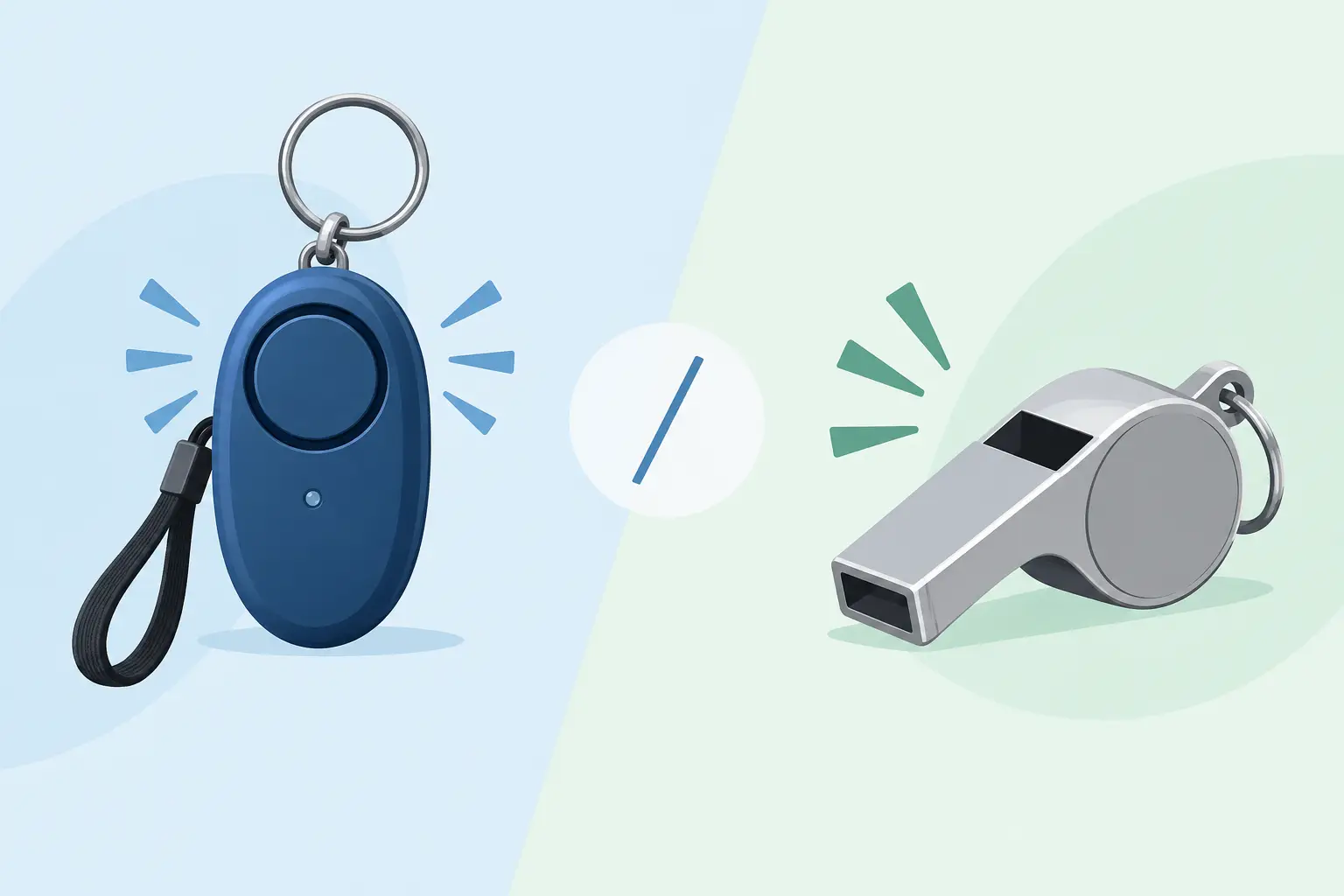
A personal alarm uses a battery-powered electronic siren. Most models activate with a pull pin, push button, or switch and produce a piercing sound designed to attract attention. Many alarms also include a flashing light, which can make you more visible in a dark garage, apartment hallway, or roadside situation.
A whistle is entirely mechanical. You blow into it to create a loud signal. It needs no batteries, can work in wet conditions, and can be used repeatedly as long as it is not damaged or blocked. Emergency whistles are usually louder and more durable than the small novelty whistles people remember from school or sporting events.
The key distinction is effort. A personal alarm makes noise after a simple activation motion. A whistle requires breath, coordination, and repeated blowing if you need the sound to continue. That difference matters when your hands are shaking, you are short of breath, or you are trying to move away at the same time.
When a Personal Alarm Has the Advantage
For many adults, a personal alarm is the stronger everyday option because it delivers sustained sound without ongoing physical effort. Pull the pin or press the activation control, create a loud disturbance, and focus on getting to a safer location. You do not have to keep blowing while you call for help, run toward a business, or unlock your vehicle.
That sustained sound can also change the dynamics of an encounter. Someone acting suspiciously may not want witnesses, cameras, security staff, or nearby residents to notice. A loud siren does not guarantee a person will leave, but it can interrupt surprise and draw attention when silence would benefit them.
Personal alarms are especially practical for commuting, walking a dog after dark, using parking garages, traveling, and checking a mailbox or apartment entrance at night. They are also a smart option for older adults or anyone with respiratory limitations who may not be able to blow a whistle forcefully for long.
There are trade-offs. Batteries can weaken, devices can be accidentally activated in a bag, and low-quality alarms may not perform as expected. A personal alarm also needs to be positioned where you can reach it immediately. Buried at the bottom of a purse, it is not ready when you need it.
Features that make an alarm easier to use
Look beyond the advertised decibel number. A loud alarm is useful, but usability determines whether it helps in a stressful moment. A secure keyring, a simple pull-pin design, and a shape you can grip without looking are often more valuable than extra features you may never use.
A strobe light can improve visibility, particularly when you are signaling for help near traffic or in a dark outdoor area. Test the activation method when you receive the alarm. Learn exactly how much force the pin requires and how to shut it off safely. That small practice session builds confidence before the tool matters.
When a Whistle Is the Better Choice
A whistle earns its place because it is simple and dependable. It does not need charging, does not rely on electronics, and can sit in an emergency kit for years. For hiking, camping, boating, storm preparedness, and backcountry travel, a whistle is often the better primary signaling tool.
Its sound can travel well outdoors, especially when you use short, sharp blasts rather than one long breath. Three blasts are widely recognized as a distress signal in many outdoor settings. If you are injured, separated from your group, or unable to use a phone, a whistle can preserve your voice while signaling over time.
A whistle can also be a sensible backup for daily use. It is lightweight, inexpensive, and unaffected by a dead battery. Parents may prefer one for a child who is old enough to understand when and how to use it. In a school, park, or neighborhood setting, clear instructions are essential so it is not treated as a toy.
The limitation is direct: you must keep using it. If you are gasping for air, speaking with 911, carrying a child, or trying to open a door, the sound stops when you stop blowing. In a close-range encounter, placing a whistle in your mouth may also feel less natural than pulling an alarm pin while moving away.
Choose Based on Where and How You Move
Your daily routine should guide your choice. A city commuter who walks from a train station to a parking lot may benefit most from a personal alarm attached to a keychain, belt loop, or outer bag strap. A trail runner or camper should strongly consider a whistle, even if they also carry an alarm for use around town.
If you work late shifts, travel alone, or regularly enter poorly lit parking areas, an alarm with a bright light offers an extra visibility advantage. If you spend time around water, in extreme cold, or far from stores and battery replacements, a whistle provides dependable low-maintenance signaling.
For the best coverage, carrying both is reasonable. This is not overkill when each item has a clear job: a personal alarm for fast, sustained attention during everyday movement, and a whistle for outdoor signaling or as a no-battery backup. Keep them in separate, easy-to-reach locations so one does not interfere with the other.
Sound Is Only Useful if People Can Hear It
Do not assume loudness alone determines effectiveness. A 130-decibel alarm may sound impressive, but distance, walls, traffic, wind, and whether people are nearby all affect who hears it. In a noisy downtown area, an alarm or whistle may be noticed by people close by but not by someone several blocks away. In a quiet neighborhood, the same sound may bring attention much faster.
Your response after activating the device matters just as much. Move toward light, people, open businesses, security personnel, or a populated entrance. Use clear words if you can: “Call 911,” “I need help,” or “This person is following me.” Specific instructions are more likely to prompt action than general shouting.
Do not stay in place simply because your alarm is sounding. The goal is not to win an argument or prove a point. The goal is to create attention, gain time, and get away from the risk.
Carry It Where You Can Reach It
The most common failure is not choosing the wrong device. It is carrying a good device in the wrong place. A tool that takes ten seconds to find may as well not be there during a fast-moving situation.
Before leaving home, make a quick habit of checking four things:
- Your alarm or whistle is on your person, not buried in a bag.
- You can activate it with either hand.
- You know how to silence or reset it after a test.
- Your phone has enough battery to call for help and share your location.
Practice without creating a scene. Handle the alarm while seated in your car, at your front door, or in another safe private space. If you choose a whistle, try a few controlled blasts outdoors and learn how it sounds. Familiarity reduces hesitation.
A Safety Tool Is Strongest as Part of a Plan
Personal alarms and whistles are attention tools, not magic shields. They cannot guarantee help will arrive immediately, and they do not remove the need to trust your instincts. If a situation feels wrong, create distance early. Change direction, enter a public business, call someone, or contact emergency services before you are isolated.
Consider pairing your signaling device with practical habits: keep your head up while walking, avoid distractions in transition areas, park in visible locations when possible, and let a trusted person know when you expect to arrive. Elite Warrior Defense encourages safety choices that are simple enough to use consistently, because preparation works best when it fits real life.
Choose the device that matches your routine, test it before you rely on it, and keep it within reach. The right signal at the right moment can turn a quiet, uncertain situation into one where other people know you need help.