

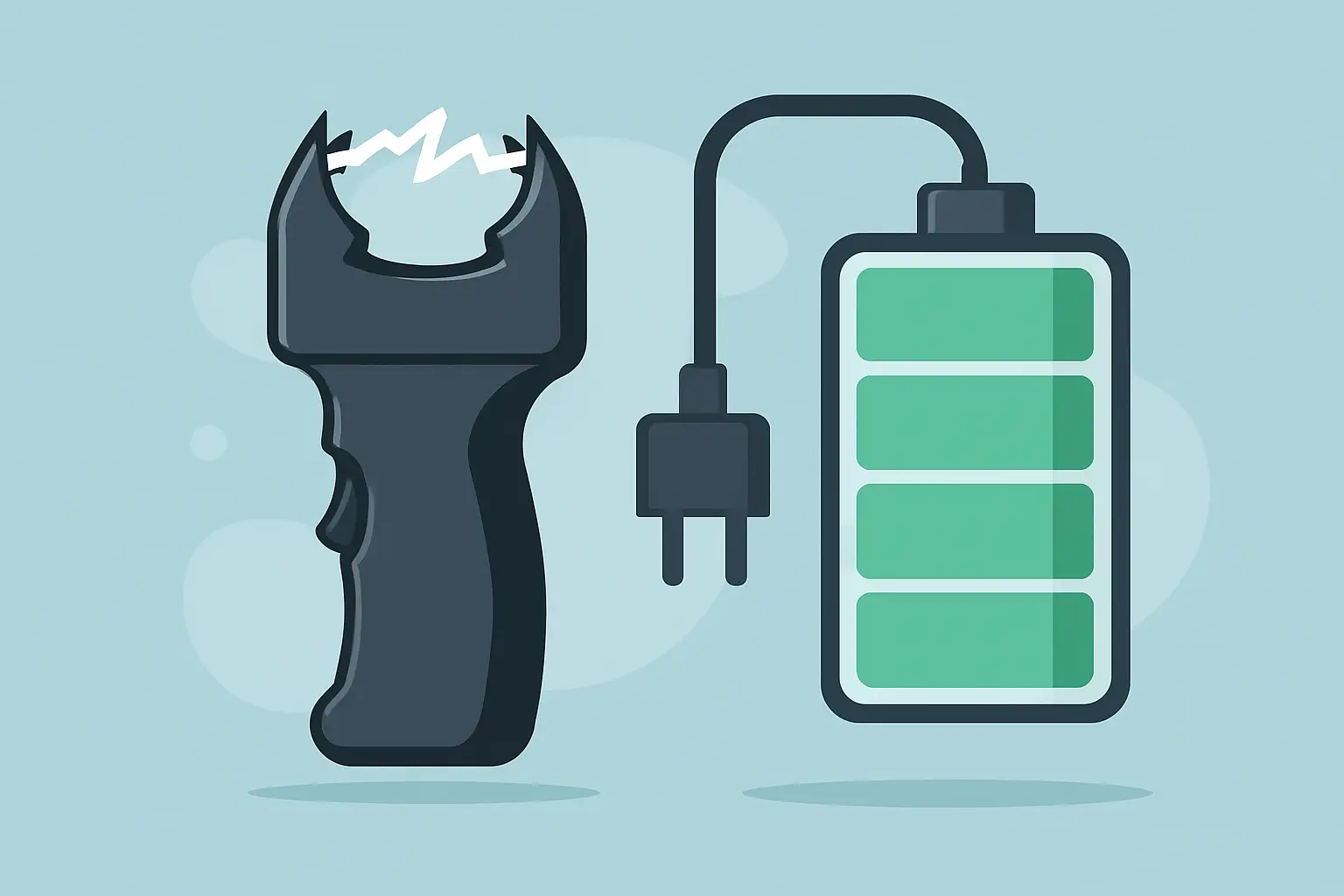
You do not buy a stun gun because you enjoy gadgets. You buy it for the one moment you might need it, and in that moment, a dead battery is the same as no protection at all. Battery care is not “extra.” It is the difference between a device that’s ready and a device that only looks ready.
Most stun guns today run on rechargeable batteries (often lithium-based), though some models use replaceable batteries. The good news is battery care is simple. The bad news is most failures come from a few preventable habits: leaving it uncharged for months, topping it off incorrectly, storing it in the wrong conditions, or never testing it until it matters.
A stun gun’s battery ages in two ways: calendar aging (time) and cycle aging (charge and discharge). You cannot stop time, but you can slow down avoidable wear with the right routine. The goal is steady readiness, not constant charging.
If your stun gun has an internal rechargeable battery, treat it like a serious piece of safety equipment. Charge it on a schedule that matches how you carry it and how long it sits. If you keep it in a purse, glove box, nightstand, or work bag, it is easy to forget it until you need it. You want a habit that makes “ready” automatic.
Start by checking the manual or product listing for your model. Many modern stun guns use lithium-ion or lithium-polymer rechargeable packs. Some older or budget models may use replaceable alkaline batteries or rechargeable NiMH cells.
Here is the trade-off. Lithium rechargeables generally hold charge well and deliver strong output, but they dislike extreme heat and deep discharge (letting them run to empty). Replaceable alkalines are easy to swap in an emergency but can leak when stored too long, and their voltage drops as they age. NiMH rechargeables are more forgiving than lithium in some ways, but they self-discharge faster sitting on a shelf.
If you are not sure, default to conservative care: avoid heat, avoid fully draining it, and use the charger made for that device.
The simplest charging plan is the most reliable: short, regular top-offs instead of long periods of neglect. Many owners wait until they “remember,” then do a marathon charge the night before travel. That is where surprises happen.
If you carry your stun gun often, a weekly check and a brief recharge when needed keeps you in the safe zone. If it mostly lives at home, a monthly check is usually enough. Some models have battery indicators, but do not treat them like gospel. Indicators can lag behind actual performance, especially as the battery ages.
Avoid letting the battery drop to zero, especially with lithium-based batteries. Deep discharge stresses the battery and can shorten lifespan. It also increases the chance you will store it “empty,” which is how devices end up dead when you pull them out months later.
Use the charger and cable specified for your stun gun. Mixing chargers can lead to undercharging, overheating, or charging at the wrong rate. A stun gun is not the place to experiment with whatever USB block is closest.
If your unit plugs directly into the wall, make sure the prongs fit securely. If it charges via a port, keep the port clean and avoid yanking the cable out at an angle. A loose charging connection can look like it charged, but it never actually topped off.
Some devices have protection circuits that reduce risk, but “set it and forget it for days” is still not a smart habit. Long, unattended charging can add heat and stress over time. A safer routine is to charge for the recommended time, then unplug it and put it back where you store it.
It depends on the model – some can be left on a maintenance charge, some should not. If your manual warns against overcharging, follow that instruction strictly.
Batteries hate extremes. High heat is the fastest way to age a battery, and freezing temperatures can temporarily reduce output. A stun gun left in a car can see both in the same week.
If your stun gun is part of your everyday carry, consider bringing it inside when you get home rather than leaving it in a vehicle. If you do keep it in a car for specific reasons, expect you will need to check and charge it more often, and accept that its battery may not last as many years.
Humidity and dust matter too. A clean, dry drawer or case is better than a damp gym bag pocket. If you store it in a purse or bag, keep keys and metal objects away from contacts and switches. You are protecting not just the battery, but the device from accidental activation or damage.
You want confidence, not guesswork. But constant testing can drain the battery faster than you expect.
A brief function check is enough for most users. Many stun gun owners do a quick 1-second test weekly or monthly, then recharge if their model typically needs it after testing. Avoid repeated, extended “arc displays.” They look impressive, but they are not free. They pull power, create heat, and can shorten the time your device stays ready.
Also, do not test a stun gun near flammables or in environments where a spark could be dangerous. This is safety gear – treat it with the same seriousness you would give any defensive tool.
Batteries do not usually fail all at once. They fade.
If your stun gun takes longer than normal to charge, seems to lose charge quickly while sitting, or produces a weaker sound or light (depending on the model), those are red flags. Another common sign is inconsistency: it works fine after charging, then feels underpowered a week later even with minimal use.
It is tempting to blame the device, but it is often the battery aging or a charging connection issue. Check the charger, the port, and the outlet. If everything else is solid, the battery may be nearing the end of its useful life.
If your model uses replaceable batteries, inspect for corrosion or leakage before you insert new ones. If you see residue, do not ignore it. Clean it carefully per manufacturer instructions, and do not store alkaline batteries in the device for long periods if it is rarely used.
The most common battery failure story goes like this: “I bought it, charged it once, put it away, and months later it was dead.” That is not a defect. That is normal self-discharge plus time.
If you store your stun gun for extended periods, check it on a calendar. Set a reminder every 30 to 60 days, do a quick indicator check or brief function test, then top it off if needed. If your device has a safety switch, keep it engaged, but do not assume “safe” means “maintenance-free.”
For lithium-based batteries, storing at a partial charge can be healthier than storing at 100% for very long periods, but readiness matters. If your stun gun is part of your emergency plan, prioritize being charged and tested over theoretical battery longevity. A battery that lasts an extra year is not helpful if it is half-dead when you need it.
If you travel, especially by car across hot states or during winter, your battery routine needs to tighten up. Temperature swings and vibration can expose weak charging ports or loose connections.
After a trip, do a quick check at home. If your stun gun has an indicator, verify it. If it does not, do a brief test, then charge according to the manufacturer’s recommendation. When you are carrying daily, consider a consistent “home base” spot so it is not buried in a bag where the charging port collects debris.
If you keep multiple self-defense tools, do not assume you will “just use something else” if your stun gun battery is low. Redundancy is smart, but it is not an excuse to neglect readiness.
Some stun guns allow battery replacement; others are sealed units. If your battery life becomes unpredictable, the safest move may be replacing the battery (if supported) or replacing the device.
It depends on your risk tolerance and how you use it. If this is a nightly dog-walk tool or something you carry while commuting, reliability matters more than squeezing out the last few months of a tired battery. If it is a backup home device and you maintain it consistently, you may have more flexibility.
If you are shopping for a new unit or adding a second device for redundancy, Elite Warrior Defense carries personal security options designed for real-life use, not wishful thinking. Whatever you choose, build your battery routine at the same time you learn the controls.
Stun gun battery care tips are not complicated, but they do require discipline: charge on a schedule, store it away from heat, test briefly, and take warning signs seriously. If you want real peace of mind, make battery checks as normal as locking your door. Your future self will not be impressed by the strongest stun gun on the market if it is sitting there with an empty battery.






YOU’RE IN!
Use this code on every order
🎉
Here’s Your Code!
Use it now an on every future order.
YOUR DISCOUNT CODE
We also sent this code to your email for safekeeping.
EXCLUSIVE OFFER
Every order – not just your first!
Unlock Your Discount Instantly
Enter your email below and your personal 15% discount code appears right here – no need to check your inbox.
🔒 We respect your privacy. Unsubscribe anytime.