
Someone grabs your wrist in a parking lot. Your heart jumps, your brain races, and you don’t get a second chance to pick the right tool. That’s why the “stun gun vs taser difference” isn’t trivia – it’s a real-world decision about distance, control, and what you’re comfortable carrying.
People often use the words “stun gun” and “taser” like they mean the same thing. They don’t. They’re both electronic self-defense tools, but they’re built for different situations and they behave very differently under stress.
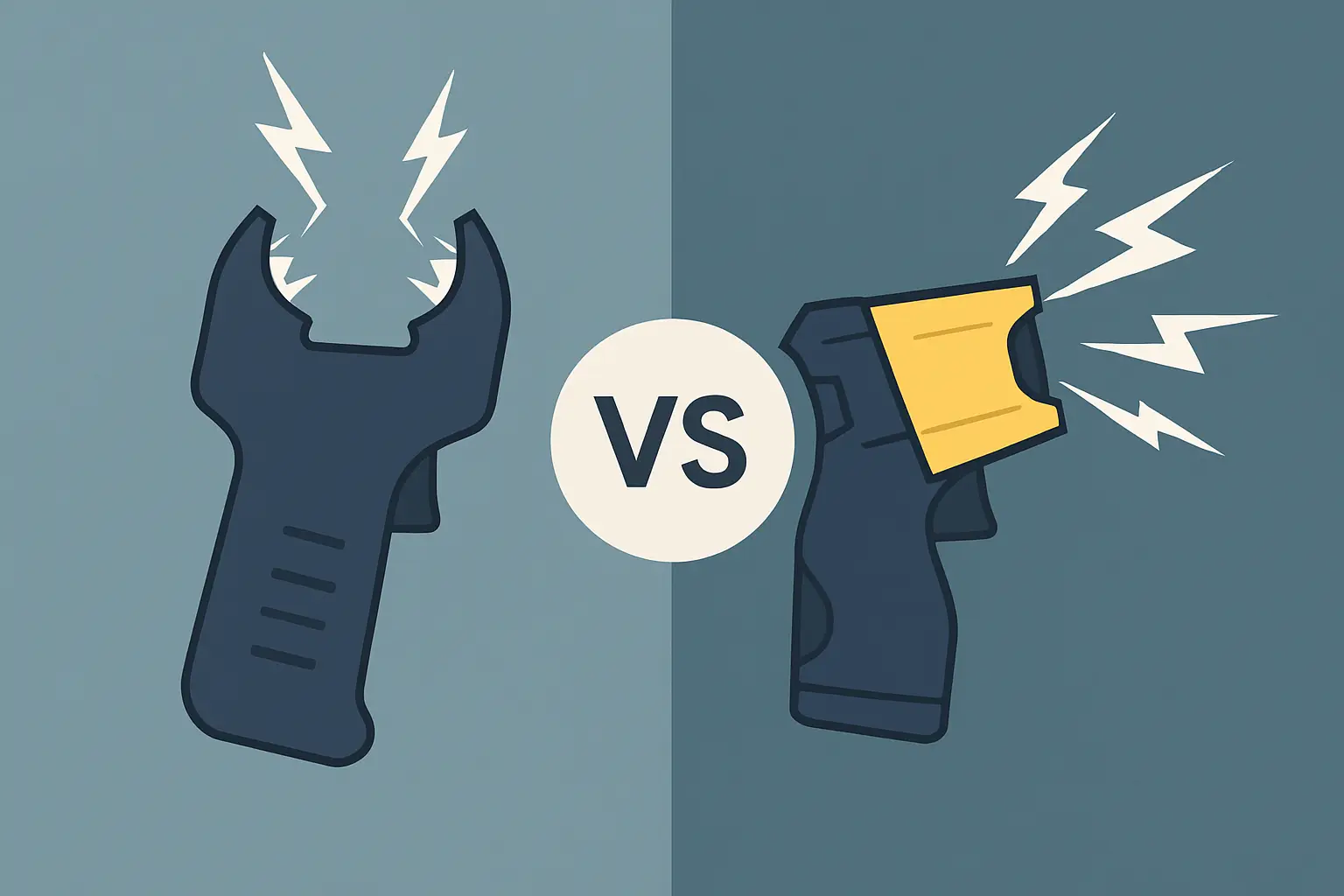
A stun gun is a close-contact device. It requires you to touch the device to the attacker’s body to deliver an electric shock. Think “press and activate.”
A TASER (often used to mean a projectile stun device) is designed to work at a distance. It fires probes that can attach to clothing or skin and deliver an electrical charge over space, giving you a chance to stop a threat before it’s within arm’s reach.
That one distinction – contact vs distance – drives almost every other difference: how you carry it, how you train with it, how likely you are to use it effectively, and what can go wrong.
A stun gun delivers a high-voltage, low-amperage charge between two metal prongs on the front of the device. When pressed against an attacker, that charge causes intense pain and muscle disruption at the point of contact.
In practical terms, a stun gun is primarily a pain-compliance tool. It can create a strong window to break contact, back away, and get to safety – especially if you drive the prongs into a large muscle group. But you should not assume it will automatically “drop” every attacker on command. Human bodies vary, clothing varies, and determination varies.
Stun guns tend to shine in the exact moment when someone is already too close. If the threat is within grappling range, distance tools may no longer be an option. A contact device is.
A TASER-style device uses a cartridge to fire two probes attached by thin wires. If those probes land with enough spread, the electrical pulse can disrupt muscle control more broadly than a typical contact stun device.
Distance is the big advantage. If you can stop a threat from several feet away, you’re buying time – time to create space, time to escape, time to call 911. That’s powerful.
But range introduces its own issues. A distance device is only as effective as probe placement, clothing penetration, and whether both probes connect well enough to complete the circuit. If one probe misses or the spread is too narrow, performance can be reduced.
If you’re choosing between the two, start with a hard truth: most everyday self-defense situations are chaotic and fast.
A stun gun is straightforward under pressure because it doesn’t require a “hit” at distance. If you can make contact and activate it, it works as designed. The trade-off is obvious – you must be close enough to touch the attacker, which can be scary and may be physically difficult if you’re smaller or you’re already being controlled.
A TASER-style device can be a confidence booster because it gives you space. The trade-off is that it asks more of you in the moment: correct orientation, clear line of fire, and the ability to manage what happens if the first shot doesn’t connect the way you need.
Neither option replaces awareness, good boundaries, and a simple plan: create distance, get to safety, and involve law enforcement as soon as possible.
This is where marketing can get loud and reality needs to stay honest.
A contact stun gun typically causes intense localized pain and can create muscle disruption at the contact point. Many people will disengage immediately because it’s overwhelming. But a highly motivated attacker, someone under the influence, or someone wearing thick clothing may not react the way you expect.
A probe-based TASER-style device is generally associated with neuromuscular disruption when the probes land well. That can produce a more “system-wide” effect for a short duration. But again, it depends on probe connection, spread, and the specific device.
The safest mindset is this: your device’s job is to create an opportunity to escape, not to “win a fight.” You’re not trying to prove toughness. You’re trying to go home.
The best self-defense tool is the one you’ll realistically carry.
Stun guns often come in compact formats that fit easily in a purse, glove compartment, or even a pocket depending on the model. Many include built-in lights, which matters because threats love low visibility.
TASER-style devices are often bulkier due to the cartridge system and design requirements. That doesn’t mean they’re impractical, but it does mean you should think about your daily routine. Are you carrying it on walks? Keeping it by the front door? Moving it between a car and a bag? Your habits decide whether you’ll have it when you need it.
A contact stun gun has fewer moving parts and fewer “variables” in use. The most common issues are battery maintenance, user hesitation, or failing to maintain contact long enough to create a break in the attack.
With a probe-based device, you add more variables: cartridge readiness, probe spread, heavy clothing, a moving target, and what you do if the first attempt doesn’t connect. That’s not meant to scare you off. It’s meant to push you toward honest practice and a backup plan.
If you choose an electronic tool, commit to basic readiness: keep it charged, store it where you can access it quickly, and practice drawing and aiming safely with whatever training method the manufacturer provides.
Most people don’t freeze because they “lack courage.” They freeze because they haven’t rehearsed.
Stun guns tend to be simpler to learn: grip, safety, activation, and where to target. A TASER-style device adds aiming and distance judgment.
If you’re a busy adult with limited time, don’t ignore the simplicity factor. Confidence comes from clarity. Clarity comes from repetition.
Self-defense laws vary widely across the US, and electronic defense tools are no exception. Some states or cities restrict certain devices, require permits, or limit where you can carry them.
Before you buy or carry, check your local and state regulations. Also think about “rules of the road” in daily life: workplaces, government buildings, schools, and event venues may have their own policies even when state law is permissive.
This isn’t about red tape. It’s about keeping you protected and compliant so your self-defense choice doesn’t create a second problem later.
It depends on what you’re planning for.
If your biggest concern is a threat that gets too close – a grab, a shove, someone rushing you at your car door – a stun gun can be a practical choice because it’s immediate and simple.
If your biggest concern is stopping someone before they can reach you, a distance-capable TASER-style device can be appealing because it helps you keep space.
Many people also choose to layer their safety approach. A small electronic device, a bright safety light, and an alarm can work together. You’re building options, not betting everything on a single moment.
If you’re looking for a straightforward place to compare everyday personal safety gear in one spot, Elite Warrior Defense carries a wide range of self-defense and home security tools designed for practical, real-world use.
Ask yourself these questions honestly.
Where will I carry it most days – pocket, purse, car, bedside? If it won’t live within reach, it won’t help you.
Am I more likely to face a close-contact situation or do I want the advantage of distance? Your environment matters: parking garages, dog walks, late-night commutes, and solo errands all create different risk profiles.
Will I actually practice drawing it and using it under stress? Choose the tool you’ll train with, not the one that just sounds best.
Can I maintain it? Battery-powered tools need charging. Distance devices may require more attention to readiness.
The goal isn’t to carry something that makes you feel invincible. The goal is to carry something you understand, can access quickly, and will use decisively to create space and get away – because your safety is worth planning for before you ever need it.

YOU’RE IN!
Use this code on every order
🎉
Here’s Your Code!
Use it now an on every future order.
YOUR DISCOUNT CODE
We also sent this code to your email for safekeeping.
EXCLUSIVE OFFER
Every order – not just your first!
Unlock Your Discount Instantly
Enter your email below and your personal 15% discount code appears right here – no need to check your inbox.
🔒 We respect your privacy. Unsubscribe anytime.