
A common moment: you are unlocking your front door with groceries in one hand, keys in the other, and your attention split between the lock and the dark driveway. That is exactly when a small safety tool earns its keep – not because you are looking for a fight, but because you want options.
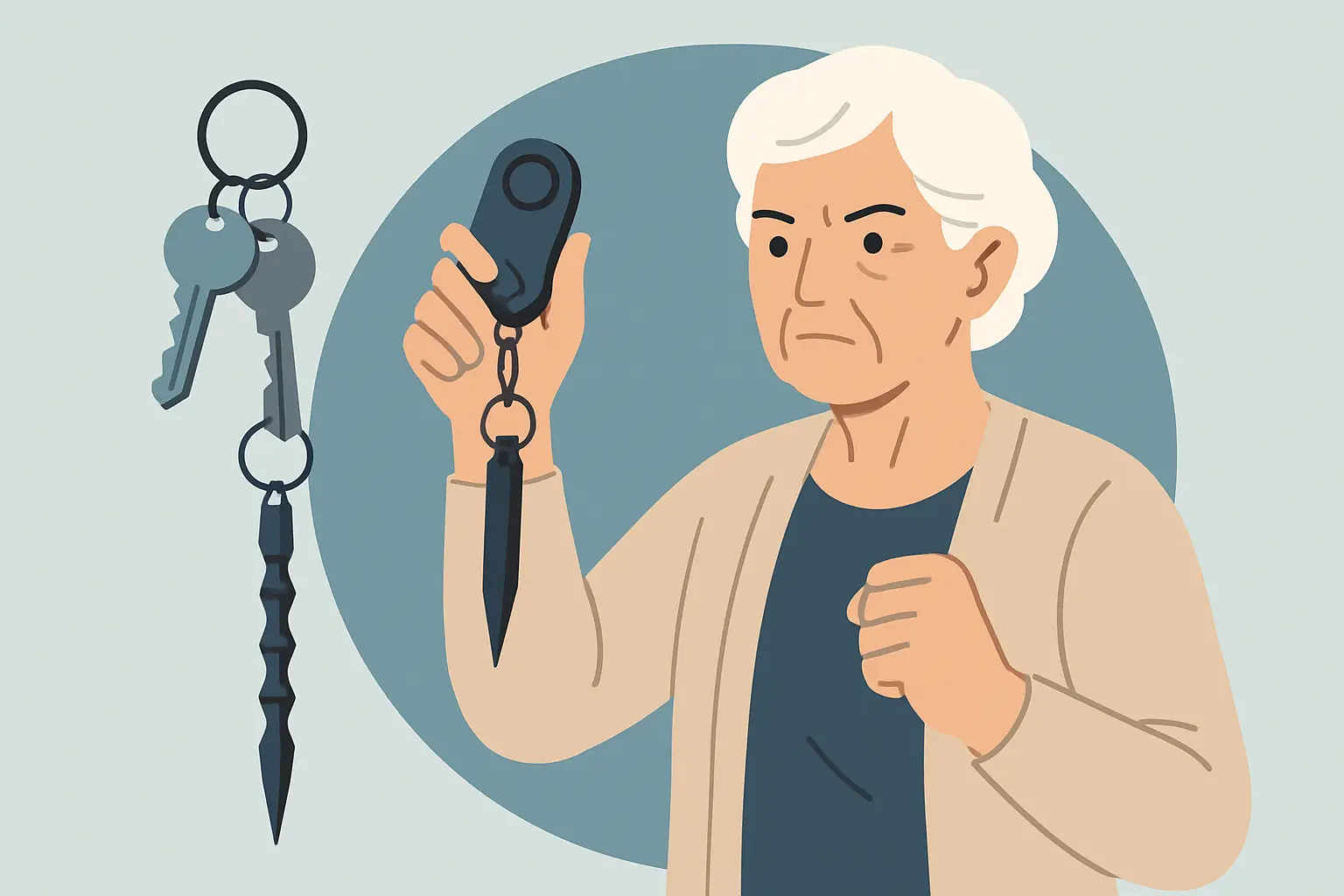
A self defense keychain for seniors can be one of the most practical everyday carry items because it is already tied to something you never forget: your keys. But not every “self-defense keychain” is senior-friendly, and some popular designs can actually increase risk if they are hard to hold, easy to drop, or legally questionable. The goal is simple: a tool you can access fast, control confidently, and use without complicated steps.
A good keychain tool does three jobs: it buys time, creates space, and helps you get away. That might mean a loud alarm that pulls attention to you, a light that blasts an attacker’s vision long enough to move, or a defensive tool that discourages someone from closing distance.
For seniors, the “how” matters more than the hype. If arthritis, reduced grip strength, a cane, or a walker is part of daily life, the best choice is the one you can operate under stress with one hand and minimal fine motor skills. Fancy mechanisms are not your friend when adrenaline hits.
Most seniors are not dealing with movie-style attacks. Real-life risks are usually close-range and opportunistic: someone crowding you at an ATM, a grab for a purse, a shove near a car door, an aggressive dog on a walk, or a stranger trying to steer you into “help” you did not ask for.
That is why keychain tools that emphasize distance and attention are often a smarter first step than anything that requires you to stay in contact with an attacker. “Distance” can be as simple as a bright light in the eyes, a cloud of spray that makes breathing and seeing difficult, or a noise that makes a criminal feel exposed.
You do not need a long list of features. You need the right ones.
Grip is number one. Look for designs with a thick body, textured surface, and a shape that fills the hand. Tiny, slick, lipstick-sized tools can be hard to hang onto if your hands are cold or your grip is compromised.
Speed is next. A keychain tool should be usable in a single motion. If you have to unfold parts, remove caps that stick, or find a tiny switch, it may fail you when it matters.
Then think about carry. If it lives at the bottom of a purse, it is not really a keychain tool. The best setup is something that can hang outside the purse or ride in a consistent pocket so your hand can find it without looking.
Finally, choose something you will actually practice with. The tool you train with once a month beats the “perfect” tool that stays new in the package.
A keychain personal alarm is one of the most senior-friendly options because it does not require aim, strength, or contact. You pull a pin or press a button and it screams. That sound can startle an aggressor, draw witnesses, and give you a moment to move toward safety.
The trade-off is that alarms are not physically disabling. If a person is committed and no one responds, you still need to leave immediately and be ready with a second tool. But for many seniors, a loud alarm plus smart movement (backing away, getting to a store entrance, stepping behind a car, calling 911) is a powerful combination.
When you shop, prioritize a loud unit with a simple pull mechanism and a clip that actually holds. If it falls off your keys easily, it will not be there when you reach for it.
A compact safety light on your keyring helps you spot hazards before they become emergencies. It also buys you time in a confrontation. A high-output light aimed at the face can disrupt vision and confidence long enough to break contact.
Lights are especially useful for seniors because they work at a distance and do not rely on pain compliance. They also reduce falls by lighting steps, curbs, and dark entryways.
The trade-off is that not all “bright” lights are truly bright, and cheap switches can fail. Choose a light you can activate with a large button, not a tiny slider that requires nail-level precision.
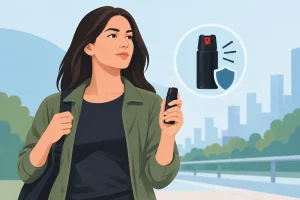
Pepper spray remains one of the most effective non-lethal tools because it creates space fast. For seniors, the best pepper spray is the one that is easy to deploy and does not require you to be within arm’s reach.
If you are considering a pepper spray keychain, focus on three senior-specific details.
First, the safety. Some are too stiff to flip; others are too easy to bump. You want a safety that is secure in a purse or pocket but simple to disengage with your thumb.
Second, the actuator. A larger, flatter button is easier than a tiny round nozzle. Under stress, you want “press and go,” not “find the sweet spot.”
Third, practice. Buy an inert trainer if available, or at least rehearse the draw and safety release. Pepper spray is not complicated, but you should know exactly how it feels in your hand.
It depends on your environment, too. Windy parking lots, crowded indoor spaces, and close quarters can increase blowback risk. If you are often indoors, a gel pattern may reduce airborne mist. If you walk in open areas, think about wind direction and moving sideways as you deploy.
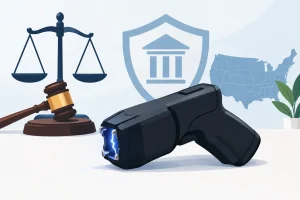
Some keychain-sized stun devices can be effective deterrents, and the crackling sound alone can make a threat rethink their plan. But seniors should be realistic about the trade-offs.
A stun device typically requires you to be very close. That means an aggressor is already within grabbing range. If you have limited mobility, that is not where you want to be.
They also require battery management. A dead device is just extra weight on your keys. If you choose one, make charging part of your routine, and confirm the local laws in your state and city.
Some keychain products are marketed as harmless but are designed to punch, stab, or mimic restricted weapons. The problem is not just legality. Many of these are difficult for seniors to hold safely. If you cannot maintain a solid grip, a tool can be taken from you and used against you.
Avoid anything that requires precise finger placement, puts pressure on small joints, or depends on you striking hard. If it hurts your hand during practice, it is not the right tool.
Most self-defense tools fail because they are not accessible. Seniors often carry keys in a purse, and purses get set down, zipped, and buried.
If you carry a purse, consider clipping your keychain tool to an exterior ring or strap so your hand can find it instantly. If you use a pocket, pick the same pocket every time. Consistency builds speed.
At home, do not toss keys into a bowl across the room. Place them near the door where you can grab them before stepping outside. The most vulnerable moment is often the transition space – doorway, driveway, parking lot, elevator.
You do not need martial arts training for a keychain tool to work, but you do need repetition.
Practice the “access” step. Can you reach it while holding a bag? Can you reach it while seated in a car? Can you reach it with your non-dominant hand?
Then practice simple movement: step back, angle away, keep your hands up, and use your voice. A strong, direct command like “Back up” or “Stay back” is not rude – it is protective.
If you use pepper spray, practice drawing and aiming at chest level (not the ground), then moving away immediately. The goal is not to stand there and evaluate results. The goal is to leave.
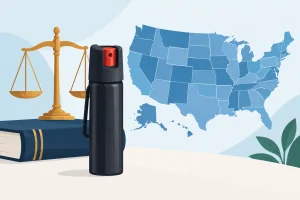
Self-defense tools are regulated differently across states and even cities. Before you buy, confirm what is allowed where you live and where you travel. If you fly, assume most defensive tools belong in checked luggage or should be left at home, depending on the item.
Also consider your own comfort. If a tool makes you nervous to carry, you will either leave it behind or fumble it. Confidence comes from a simple tool you understand.
For many seniors, the strongest setup is not one device. It is a simple pairing: an attention-getter plus a space-maker.
That could mean an alarm plus a light, or a light plus pepper spray. The light helps you see and signals awareness. The alarm brings attention. The spray creates distance if someone ignores your commands.
The right mix depends on where you live, how you move around, and how comfortable you are with deploying a defensive tool. The wrong mix is anything you cannot operate quickly.
If you want a one-stop place to choose from senior-friendly options like alarms, pepper sprays, safety lights, and self-defense keychains, Elite Warrior Defense has a wide range at https://elitewarriordefense.com/.
A keychain tool is not a replacement for awareness – it is a backup for the moments awareness is not enough.
Walk with your keys already in hand when approaching your car or front door. Keep your head up, scan ahead, and give yourself permission to change direction if something feels off. You are not being paranoid. You are being prepared.
A helpful closing thought: pick one keychain tool you can use in under two seconds, then practice it until it feels as normal as locking your front door – because calm, repeatable habits are what protect you when surprise shows up.
YOU’RE IN!
Use this code on every order
🎉
Here’s Your Code!
Use it now an on every future order.
YOUR DISCOUNT CODE
We also sent this code to your email for safekeeping.
EXCLUSIVE OFFER
Every order – not just your first!
Unlock Your Discount Instantly
Enter your email below and your personal 15% discount code appears right here – no need to check your inbox.
🔒 We respect your privacy. Unsubscribe anytime.