You already do the smart stuff. You pick routes you know. You share your location. You keep your head up, music low, instincts on.
But if you run long enough – early mornings, quiet trails, empty parking-lot cut-throughs – you eventually feel that moment when your pace changes for a reason that has nothing to do with training.
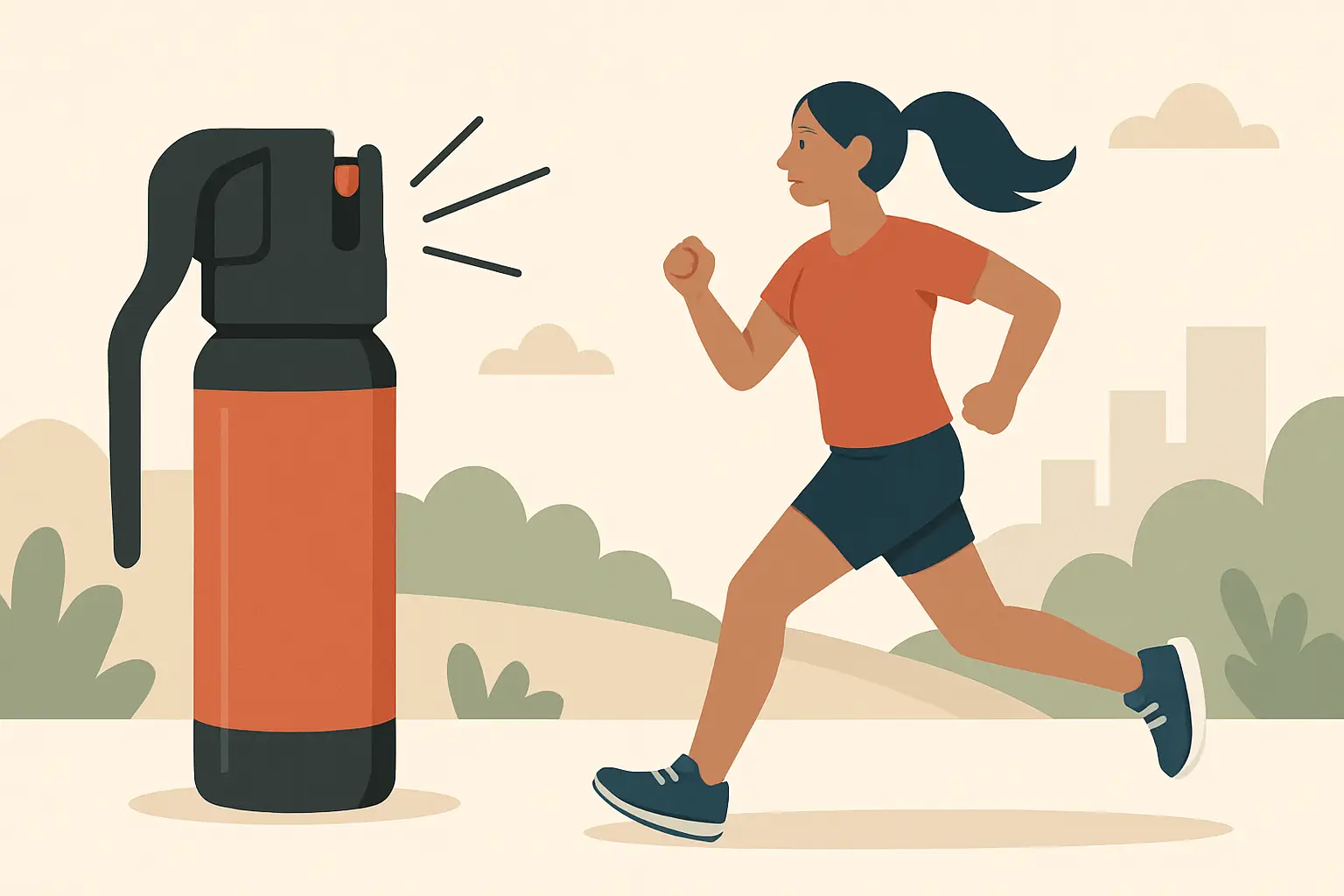
Pepper spray is popular with runners for one simple reason: it gives you a chance to create distance fast. Not to “win a fight.” Not to play hero. To break contact, get space, and get away.
What “best pepper spray for runners” really means
The best pepper spray for runners is the one you can carry comfortably on every run, access under stress, and use without guessing.
A big canister with great range does you no good if it stays in the glove box because it bounces, chafes, or feels annoying. On the other hand, the tiniest keychain unit isn’t a great choice if it’s hard to aim, easy to misfire, or too short-range for your typical running environment.
So “best” is a balance of five things: carry, access, range, spray pattern, and reliability. Your route, your pace, your climate, and your comfort level decide the winner.
How runners should choose pepper spray
Size and weight: small enough to bring, big enough to trust
For runners, compact usually wins. You want something light that won’t drag down a waistband or slap against your thigh. But avoid going so micro that you sacrifice control.
A practical middle ground is a small canister designed for hand carry or clipped carry, with a grip that doesn’t disappear in your palm. When your heart rate is high and your hands are sweaty, “tiny” can turn into “fumble.”
Range: think in real-world steps, not marketing
Range matters because distance is time. On a sidewalk, a few feet can be the difference between a clean disengagement and someone being too close.
As a runner, you’re usually moving. That means you want enough reach to create a barrier without having to stop and let the threat close in. If your typical runs are on open roads or wide paths, a longer effective range is a meaningful advantage. If you run tight trails with turns and brush, you may prioritize quick deployment over max distance.
Spray pattern: stream vs. cone (and what runners should pick)
Most people talk about this like there’s one “right” answer. There isn’t.
A stream pattern is more focused. It tends to reach farther and is less likely to drift everywhere. That’s a strong fit for runners because it’s easier to use while backing away or moving sideways and it reduces the chance of contaminating yourself.
A cone or fog pattern can be more forgiving on aim, but it’s also more affected by wind. If you run in gusty conditions or along open waterfront routes, a wide mist can become your problem fast.
If you want the simplest runner-friendly choice, start with a focused stream.
Flip-top safety and one-handed use
Under stress, fine motor skills drop. You want a safety mechanism that’s hard to accidentally set off in your bag but easy to operate with one hand.
Flip-top designs are popular for a reason: they’re quick, intuitive, and don’t require you to twist multiple parts while you’re panicking. Whatever you choose, practice the motion until it’s boring.
Reliability: expiration dates and “it lived in my car” mistakes
Pepper spray is a tool, not a talisman. If it’s expired, leaking, or has been cooked in extreme heat for years, you’re gambling.
As a runner, you’ll expose it to sweat, humidity, and temperature swings. Check the canister periodically. If the cap is cracked, if it smells like chemicals, or if the actuator feels loose, replace it. The best time to learn your spray failed is never.
Carry options that actually work while running
Your carry method matters as much as the spray itself. If you can’t access it instantly, you’re basically carrying dead weight.
Hand-carry is the fastest. If you run in areas where you’ve had uncomfortable encounters, carrying it in your hand can be a solid choice. The trade-off is obvious: you’re dedicating a hand, which can feel awkward for long runs and can affect form.
A waistband clip can work well if the clip is strong and the canister rides securely without bouncing. The key is positioning. Front-of-hip can be easy to reach, but make sure it won’t jab you with every stride.
A running belt pocket is comfortable and discreet, but access can be slower. If you choose this, keep pepper spray in its own consistent spot, oriented the same way every time. You want muscle memory, not scavenger-hunt energy.
Armband carry is hit or miss. It can be accessible, but sweat and tightness can make it annoying, and some runners find it shifts.
If you’re deciding between comfort and speed, pick speed for higher-risk routes and comfort for low-risk environments. Adjust based on where and when you run, not on what looks best.
The best pepper spray for runners by scenario
If your runs are mostly urban and populated, you’ll likely do best with a compact stream spray that’s easy to deploy quickly and won’t fog a crowd or blow back into your face. In tighter public spaces, control matters.
If you run early mornings or late evenings on quieter routes, prioritize fast access and adequate range. That’s where a hand-ready carry or a very accessible clip setup shines.
If your main concern is aggressive dogs, you still want something you can aim and deploy quickly, but you also want to be realistic. Dogs move fast, and some are surprisingly committed. Your best setup is the one you can get on target immediately without digging through pockets.
If you run trails, wind and vegetation matter. A focused stream reduces drift, but you also need to think about how you’ll carry it with hydration packs, trekking poles, or gloves.
This is why “best” depends. Your environment chooses for you.
Using pepper spray without freezing up
Owning pepper spray isn’t the same as being ready to use it.
Start by practicing the draw. Not spraying – drawing. Rehearse the motion at home: where it sits, how you grab it, how your thumb finds the actuator. Do it slow, then do it faster. Do it with your non-dominant hand too.
Next, plan a simple script. If someone is closing distance, you don’t need a debate. You need a loud command and movement.
A clear, strong “Back up!” while you create space can be enough to stop a situation early. If it’s not, your tool is already in hand.
Also be honest about wind. If it’s blowing toward you, you may need to move laterally before deploying. Distance and positioning are part of self-defense, not extras.
Legal and safety realities runners should not ignore
Pepper spray laws vary by state and sometimes by city. Some places restrict size or formulation, and some have rules about where it can be carried. Before you run with it, check your local requirements so your self-protection plan doesn’t accidentally turn into a legal problem.
And remember what pepper spray is designed to do. It’s meant to disrupt vision and breathing long enough for you to escape. It’s not a magic off-switch and it doesn’t work the same on every person.
That’s also why your post-spray plan matters: as soon as you create distance, leave. Run to a public area. Get behind a barrier. Call for help. Staying close to “see what happens” is how people lose the advantage they just earned.
Where Elite Warrior Defense fits
If you want a straightforward place to choose runner-friendly pepper spray and other practical self-defense options without overcomplicating it, Elite Warrior Defense is built for exactly that – accessible protection tools that help everyday people take control of their safety.
A runner’s final checklist before you commit
Before you label anything the best pepper spray for runners, hold it to this standard: you’ll carry it every time, you can reach it instantly, you can operate it one-handed, and you’ve practiced the draw until it feels automatic.
That’s the difference between buying pepper spray and building real peace of mind.
Helpful closing thought: pick one setup, stick with it for a month, and make it part of your pre-run routine – confidence comes from consistency, not just equipment.