

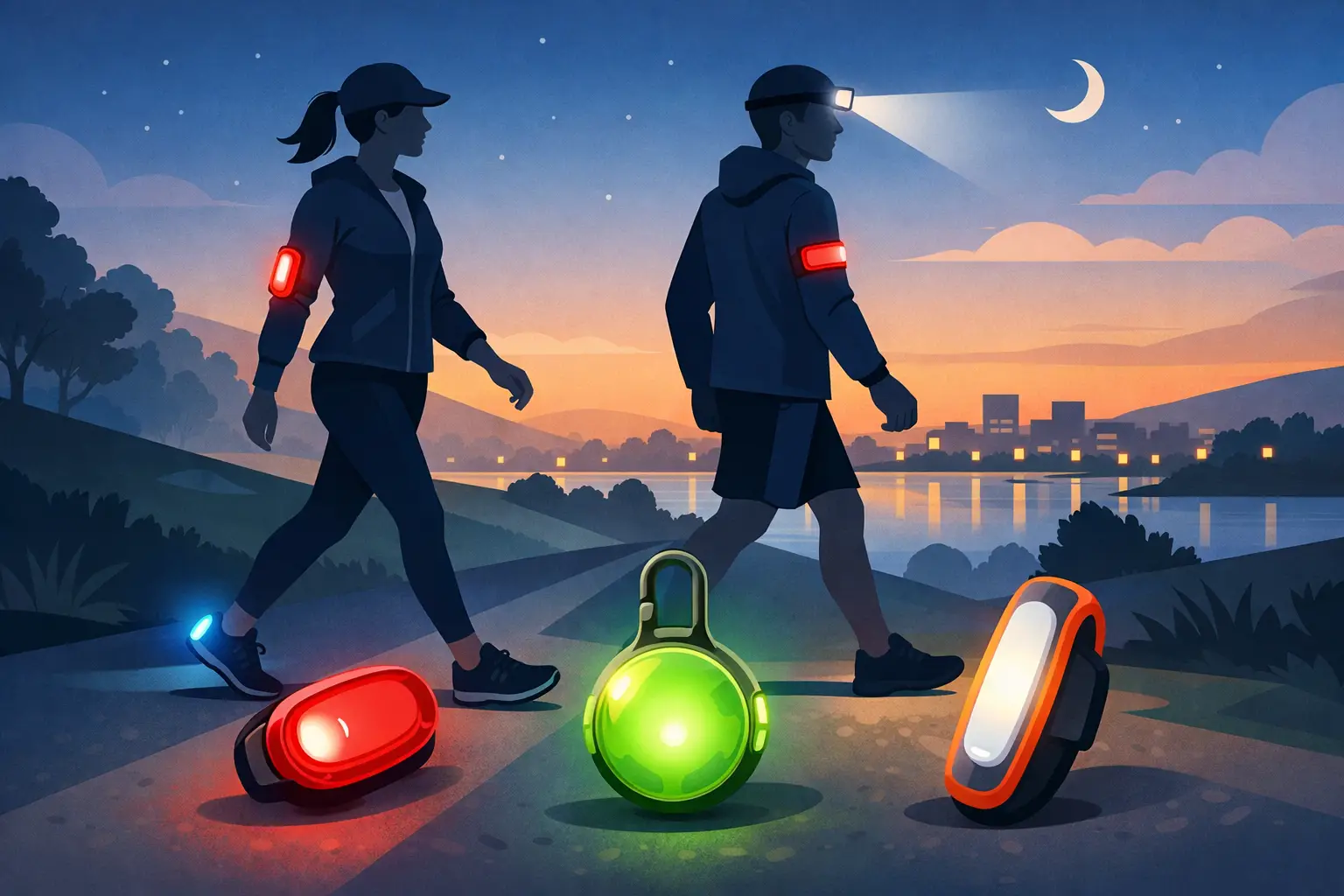
The difference between being seen and being ignored by a driver can come down to a light the size of your thumb.
If you walk at dawn, after work, or before sunrise, visibility is not a small detail. It is a safety decision. The best safety lights for walking do more than glow. They help drivers judge your position faster, make you more noticeable at intersections, and give you more control when sidewalks are dim, broken, or crowded.
That is why choosing a walking light should not be treated like grabbing the cheapest clip-on at checkout. The right light depends on where you walk, how long you are out, what you wear, and whether your biggest concern is seeing the path, being seen by traffic, or both.
A good walking safety light does two jobs. First, it makes you visible from a distance and from multiple angles. Second, it helps you stay aware of your surroundings without becoming annoying, bulky, or hard to use.
Brightness matters, but more lumens do not automatically mean better protection. A very bright white beam can help you spot cracks, curbs, debris, and uneven pavement. But if that same beam is too narrow or aimed poorly, it may not help drivers notice you from the side. That is why side visibility and placement matter just as much as raw output.
You also want a light that stays put. A light that flips over on your waistband, slides off your jacket, or bounces on every step is not dependable when you need it most. The best options are simple to activate with one hand, secure on your body or gear, and bright enough to be useful without being a hassle.
Battery type is another real-world issue. Rechargeable lights are convenient and cost-effective if you walk often. Replaceable battery lights can still make sense if you want a backup that is ready in a glove box, bag, or emergency kit. There is no perfect choice for everyone. It depends on whether you value convenience, long-term cost, or readiness.
For most walkers, a compact clip-on LED is the smartest place to start. It attaches to a jacket, waistband, backpack strap, or pocket and gives you quick visibility without changing how you dress.
This style works well because it is easy to wear consistently. And consistency is what matters. A light only protects you when it is actually on your body, not sitting in a drawer because it felt too bulky. Look for a model with steady and flashing modes, solid clip tension, and visibility from more than one angle.
An LED armband is one of the best choices for people who want visibility without carrying anything in their hands. It wraps around your upper arm or forearm and creates a clear moving point of light that drivers can notice quickly.
This is especially useful in suburban neighborhoods and near intersections, where movement catches attention better than a fixed light alone. The trade-off is fit. If the band is too loose over a coat or too tight on bare skin, you will stop wearing it.
A light-up vest offers broad visibility from the front, back, and often the sides. For walkers near traffic, this is one of the strongest options available because it combines reflective material with active lighting.
It is not the most discreet choice, and some people will find it overkill for short dog walks in well-lit areas. But if you walk on roads without strong sidewalks, cross busy streets, or go out in low-light weather, the extra visibility is worth it.
Waist-mounted lights sit lower than chest or shoulder lights, which gives them a practical advantage. They can light up the walking surface ahead without blinding other people, and they often feel more stable than hand-carried flashlights.
This style is a strong pick if your main concern is spotting hazards like uneven pavement, puddles, roots, or poor sidewalk edges. It may not offer as much upper-body visibility as a vest or armband, so many walkers pair it with a blinking rear or side light.
Shoe lights are small, lightweight, and surprisingly effective because motion draws attention. A flashing light near your feet can make your movement easier for drivers to recognize, especially from the side.
They are best used as a supplement, not your only light. Since they sit low to the ground, they can be blocked by parked cars, grass, or curbs. Still, as part of a two-light setup, they add valuable visibility without getting in your way.
A headlamp gives you direct control over where the beam goes, which is useful when you need to scan a dark path, parking lot, or trail. If your route includes poor lighting, early mornings, or uneven surfaces, a headlamp can improve both awareness and confidence.
The downside is that some walkers rely on a headlamp alone, and that is not always enough. It helps you see, but depending on the design, it may not make you highly visible from all directions. It is also easy to accidentally shine it into someone else’s eyes. A headlamp is excellent for path lighting, but it works best with another visibility light on your body.
A handheld flashlight is a simple, flexible option. You can aim it where you need it, use it to check dark corners, and keep it ready if your route changes unexpectedly.
Some walkers also prefer the confidence of having a tool in hand, especially in isolated areas. Still, holding a flashlight for the entire walk can become tiresome, and a strobe mode is not always ideal in crowded spaces. It is effective in drawing attention, but constant flashing can be excessive if used carelessly.
Wearable rechargeable lights are popular for a reason. They are easy to top off, affordable over time, and often designed for clips, belts, packs, or shirts. If you walk several times a week, this category usually makes the most sense.
The main thing to watch is charging discipline. A rechargeable light that is dead when you need it is no better than having no light at all. If you are not good about plugging gear in, you may want one rechargeable primary light and a battery-powered backup.
Some safety devices combine an LED light with a personal alarm. For walkers focused on visibility and personal security, this dual-purpose option deserves attention.
It will not replace a dedicated path light if your route is very dark. But for parking lots, apartment complexes, campus walks, or evening city routes, having illumination and an audible alert in one compact device can be a smart layer of protection. That balance of visibility and readiness fits the needs of many people who want more than a basic light.
The best setup usually comes down to where you walk. If you stay in neighborhoods with decent street lighting, a clip-on light or LED armband may be enough. If your route includes dark sidewalks or trails, you need something that helps you see the ground ahead, such as a waist light or headlamp.
If traffic is your biggest concern, prioritize 360-degree visibility. That usually means a vest, armband, or clip-on light placed where drivers can see you from multiple directions. If uneven ground is the issue, focus on beam control and stable placement.
Weather also matters. If you walk in rain, cold, or summer heat, your light has to hold up and stay comfortable over changing layers. A light that works great on a T-shirt may shift badly on a winter jacket. Small details like button size, clip strength, and water resistance become very important once you use the light in real life.
One light can help. Two lights usually work better.
A strong combination is one light for visibility and one for path illumination. For example, a flashing clip-on or armband makes you stand out to others, while a waist light or headlamp helps you see where you are stepping. That gives you better protection than relying on one device to do everything.
This is where many people go wrong. They buy a single bright flashlight and assume they are covered. But walking safety is not just about seeing the ground. It is also about being recognizable to drivers, cyclists, and anyone approaching from behind or the side.
The first mistake is choosing based on brightness alone. If the light is uncomfortable, hard to charge, or awkward to wear, you probably will not use it long term.
The second mistake is poor placement. A light buried on a bag strap under your arm is not doing much. Position matters. You want your light exposed, stable, and easy to notice.
The third mistake is skipping a test walk. Before relying on any safety light, wear it outside at the same time of day you normally walk. Check whether it shifts, reflects strangely, or leaves blind spots. Safety gear should earn your trust before you depend on it.
For walkers who want practical, reliable safety tools without overpaying, Elite Warrior Defense offers options designed around real personal security needs, not gimmicks.
The right light should make you feel more prepared the moment you clip it on. When visibility improves, confidence follows. And when confidence is backed by smart gear, every walk starts to feel a little more under your control.




YOU’RE IN!
Use this code on every order
🎉
Here’s Your Code!
Use it now an on every future order.
YOUR DISCOUNT CODE
We also sent this code to your email for safekeeping.
EXCLUSIVE OFFER
Every order – not just your first!
Unlock Your Discount Instantly
Enter your email below and your personal 15% discount code appears right here – no need to check your inbox.
🔒 We respect your privacy. Unsubscribe anytime.