
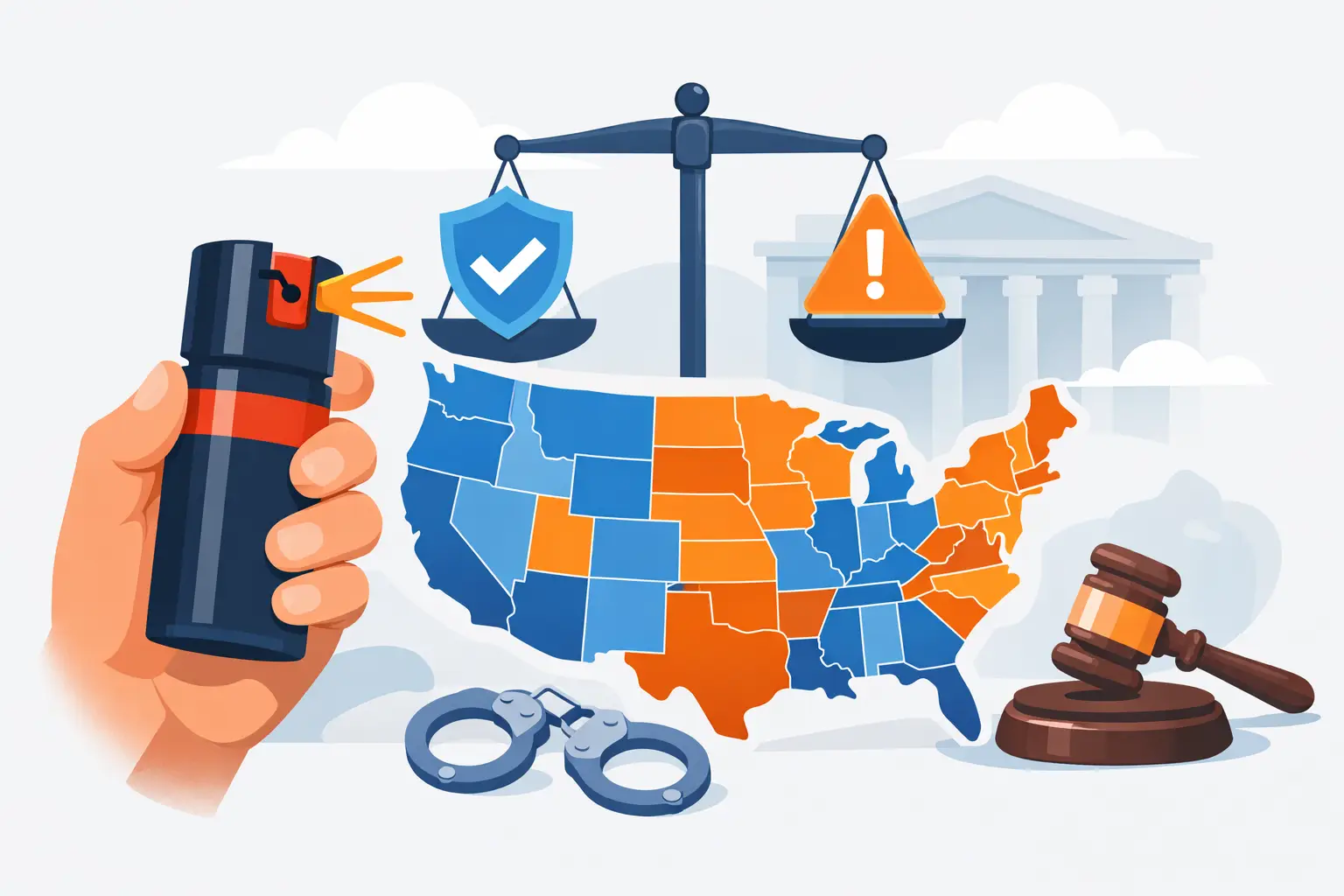
A lot of people ask the same question right before buying their first self-defense tool: is pepper spray legal in my state? It is a smart question, because pepper spray is legal in many parts of the U.S., but the rules are not identical everywhere. One state may allow standard civilian pepper spray with few limits, while another may restrict size, strength, age of purchase, where you can carry it, or how it can be shipped.
If your goal is simple – protect yourself legally and confidently – you need more than a yes or no answer. You need to know what kind of pepper spray your state allows, who can carry it, and when carrying crosses the line into a legal problem.
In most states, civilians can legally buy and carry pepper spray for self-defense. That is the broad rule. The details are where mistakes happen.
State laws often focus on a few core issues: age restrictions, container size, formula strength, criminal history, and intended use. Some states treat pepper spray as a straightforward personal safety device. Others regulate it more closely, especially in places with stricter weapons laws overall.
That means two people can both be carrying pepper spray legally in different states, but under very different conditions. One may be able to carry a larger canister on a keychain or in a purse without much concern. Another may need to stay under a specific size limit or avoid carrying it into certain locations.
Pepper spray sits in an unusual legal category. It is not usually treated the same as a firearm, but it is still considered a defensive weapon in many jurisdictions. Lawmakers often try to balance two realities: people have a real need for personal protection, and misuse can still cause harm.
That is why some states allow it freely for adults, while others layer on conditions. In certain places, the law is shaped by broader views on self-defense rights. In others, lawmakers put more weight on restrictions tied to public safety, minors, or prior criminal convictions.
This is also why old advice can get people in trouble. Pepper spray laws do change. A forum post from three years ago or a social media comment from someone in another state is not a reliable legal standard.
If you are trying to answer, is pepper spray legal in my state, focus on the practical restrictions first.
Many states require buyers or carriers to be at least 18. Some states may allow minors to possess pepper spray with parental permission, while others are stricter. If you are buying for a college student or a younger family member, this matters.
Some states limit the amount of pepper spray in one container. That rule may sound minor, but it affects what products you can legally purchase and carry. A canister marketed as heavy-duty or law-enforcement-style may not be lawful everywhere for civilian use.
Not every self-defense spray is treated the same. Certain jurisdictions regulate the concentration of active ingredients or distinguish between standard pepper spray and combinations that include tear gas or dye. A product that is legal in one state may be restricted in another because of what is inside it, not just how big it is.
Some states limit possession for people with certain felony convictions or other disqualifying offenses. This can surprise buyers who assume pepper spray is always unrestricted because it is a non-firearm defense tool.
Even when possession is legal, direct shipping may be limited in some areas. That does not always mean the product itself is banned. Sometimes it means there are packaging, labeling, or retailer compliance issues tied to that state.
Even if pepper spray is legal in your state, that does not mean it is legal everywhere inside your state.
Government buildings, courthouses, airports past security checkpoints, schools, and some private businesses may prohibit defensive sprays. Colleges are a good example of how this gets complicated. One campus may allow pepper spray in dorms or on footpaths, while another may ban it under school policy even if state law allows civilian possession.
Workplaces can be another gray area. Your state may allow you to carry pepper spray generally, but your employer may prohibit weapons or defensive devices on company property. That does not always create a criminal issue, but it can create an employment issue.
This is where responsible self-defense matters. Carrying protection is about readiness, not recklessness. You want to know both the law and the rules of the spaces you enter every day.
The safest approach is to match the product to your state and your routine.
Start with the basics. Confirm your state’s minimum age, possession rules, and whether there are limits on canister size or spray type. Then look at where you actually plan to carry it – on a keychain, in a purse, in a car, during a commute, on campus, or while jogging.
A smaller unit is often easier to carry consistently, and consistent carry matters more than buying the biggest canister available. On the other hand, if your state allows a wider range of sizes and you want something for home entry points or vehicle storage, your choice may be different.
This is one reason buyers appreciate straightforward product information from companies that focus on personal safety. Elite Warrior Defense serves customers who want practical protection, not confusion, and that starts with choosing tools that fit real-world needs and legal boundaries.
This is where many people make the wrong assumption. A pepper spray product can be legal to own but illegal to use in the wrong situation.
Pepper spray is generally intended for self-defense against an immediate threat. Using it to intimidate, punish, threaten, or escalate an argument can lead to serious legal consequences. If there is no legitimate self-defense basis, the fact that the spray was legal to carry may not help much.
Self-defense laws also vary by state. Some states give wider protection to people responding to an imminent threat. Others may examine whether the force used was reasonable under the circumstances. Pepper spray is less lethal than many defensive tools, but that does not make every use automatically lawful.
If you carry it, carry it with the mindset that it is a protective last-resort tool. Confidence and restraint go together.
If your question is specifically, is pepper spray legal in my state, pay extra attention if you live in a state known for tighter weapons regulations. States with stricter legal frameworks may impose more conditions on who can buy pepper spray, what kind they can carry, and how it must be sold.
That does not automatically mean pepper spray is banned. In many cases, it is still legal with restrictions. But the margin for error is smaller. Buyers in these states should avoid guessing based on what friends in other parts of the country can carry.
It is also wise to be careful if you travel across state lines. A product that is lawful at home may be restricted where you are visiting. That matters for road trips, work travel, college moves, and daily commuting near state borders.
The best approach is simple. Check current state law before you buy. Confirm whether there are local rules where you live or work. Make sure the spray you choose matches your state’s requirements. Then learn how and when it can be used lawfully.
That may feel like extra effort, but it is part of responsible self-protection. The goal is not just to own a safety tool. The goal is to carry one you can actually rely on without second-guessing whether you are breaking the law.
Prepared people do not wait until after an incident to learn the rules. They handle the legal side before they ever clip a unit to a bag or place one in a glove compartment.
Sometimes there is no clean one-line answer to the question, is pepper spray legal in my state. The answer may depend on your age, your criminal history, the product formula, the container size, or where you plan to carry it.
That is not a reason to give up on carrying protection. It is a reason to be precise. Pepper spray remains one of the most accessible and practical self-defense options for many adults, especially those who want a non-firearm tool that is easy to carry and fast to deploy.
A little homework now can save you from buying the wrong product, carrying where you should not, or assuming legal use where the law says otherwise. Protect yourself with confidence, but make sure confidence is backed by facts.





YOU’RE IN!
Use this code on every order
🎉
Here’s Your Code!
Use it now an on every future order.
YOUR DISCOUNT CODE
We also sent this code to your email for safekeeping.
EXCLUSIVE OFFER
Every order – not just your first!
Unlock Your Discount Instantly
Enter your email below and your personal 15% discount code appears right here – no need to check your inbox.
🔒 We respect your privacy. Unsubscribe anytime.