A quiet road before sunrise can feel peaceful right up until a car turns the corner too fast, or a cyclist appears without warning. That is exactly why safety lights for runners are not a nice extra. They are part of a smart, practical routine for anyone who runs when visibility drops.
Running in low light changes the risk picture. Drivers have less time to react. Sidewalk cracks are harder to spot. Intersections become more unpredictable. The right light setup helps other people see you sooner, and in many cases, helps you see the road ahead more clearly too. That difference matters when a few extra seconds can prevent a close call.
Why safety lights for runners matter
A lot of runners assume reflective gear is enough. Reflection helps, but it depends on someone else shining light in your direction. A safety light creates its own visibility. That means you stand out sooner to drivers, cyclists, and even other pedestrians who may be distracted.
There is also a confidence factor that should not be ignored. When you feel visible, you run with better awareness and less hesitation. You are not second-guessing whether the driver at the stop sign can see you. You are not blending into a dark hoodie and hoping for the best. You are taking control of your visibility instead of leaving it to chance.
For runners who train early in the morning, after work, or during winter months, this is not occasional gear. It is everyday gear. If you regularly run in dim neighborhoods, near traffic, on trails, or through parking lots, lights belong on your checklist as much as your shoes do.
What a good runner safety light should do
Not every light is built for running. Some are too bulky, some bounce too much, and some are bright in the wrong way. A good running light needs to balance visibility, comfort, and real-world usability.
Brightness matters, but more is not always better. If a light is painfully bright at close range, it can distract other people and even affect your own vision. For being seen, a flashing rear red light or a bright clip-on light is often enough. For seeing where you are going, especially on dark routes, you may need a forward-facing light with a more focused beam.
Battery life is another major factor. A light that dies halfway through a run is not reliable protection. Rechargeable models are convenient, but only if you are disciplined about charging them. Replaceable battery models can be a better fit for runners who want a backup option ready to go.
Comfort and stability deserve more attention than they usually get. If a light shifts around, chafes, or feels heavy, you will eventually stop wearing it. The best light is the one you will use every time, not the one with the longest feature list.
Weather resistance is worth paying for too. Sweat, unexpected rain, and humid mornings can wear down cheap gear fast. Running gear should not fail because the forecast changed.
The different types of safety lights for runners
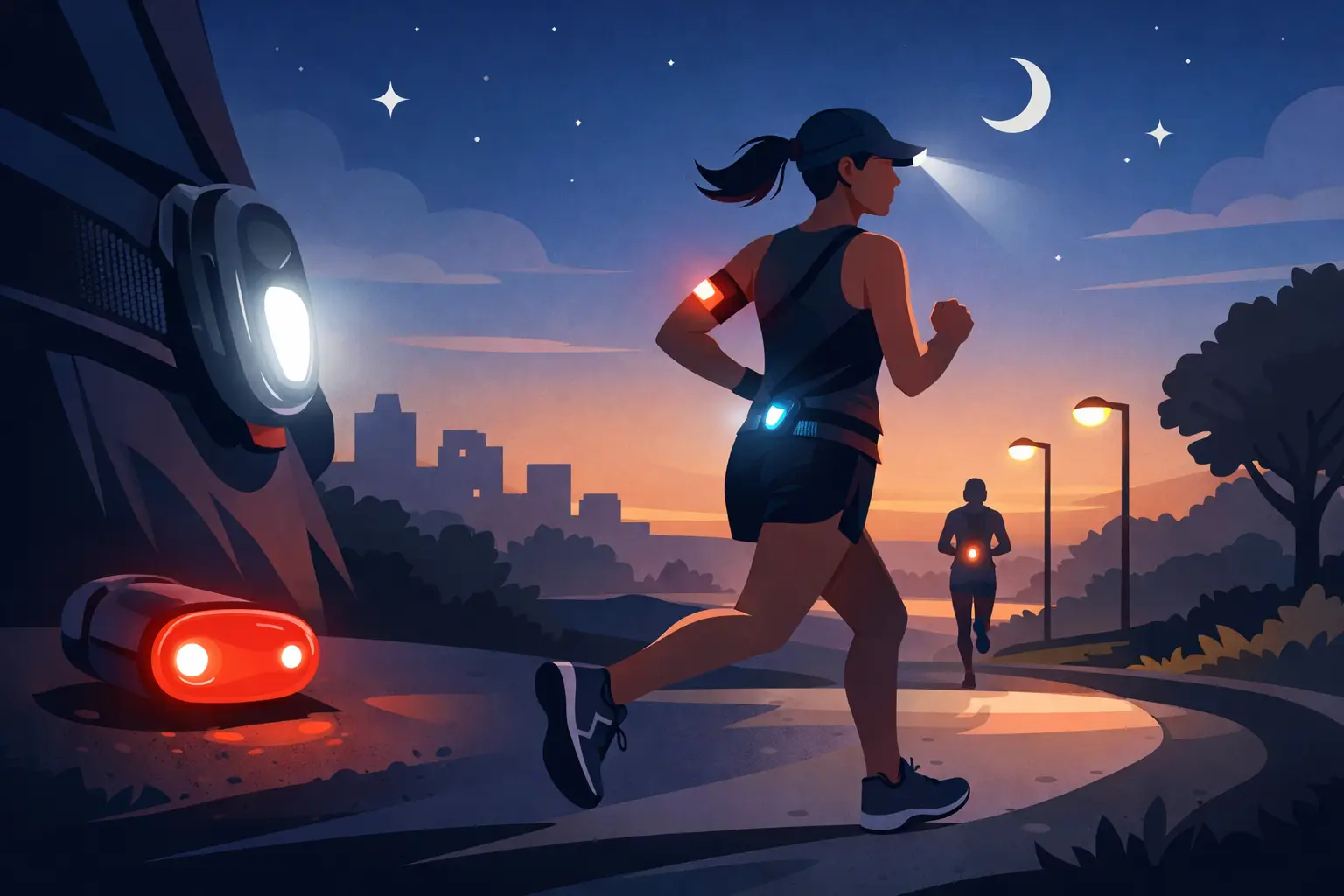
Clip-on lights are one of the simplest options. They attach to a waistband, hydration belt, hat, shoe, or vest and are easy to move between outfits. They work well for runners who want a low-profile setup and mainly need to be seen.
Armband and wrist lights offer visibility with minimal fuss. They are popular because they feel natural and stay accessible. If you want to change modes or turn the light off after your run, it is right there. The trade-off is that arm movement can make the beam less stable if you are relying on it to light your path.
Chest lights and running vests with built-in LEDs are strong choices for visibility from multiple angles. A chest-mounted light often gives a better forward beam than a handheld or wrist-mounted option because it follows your torso instead of your arm swing. Many runners also find this setup more balanced.
Headlamps are ideal when the issue is not just being seen, but seeing. If you run on trails, poorly lit roads, or uneven sidewalks, a headlamp can help you catch roots, potholes, curbs, and debris before they become a problem. The downside is that some headlamps can feel top-heavy, and a beam at eye level can be harsh for people coming toward you if it is angled poorly.
Shoe lights and heel lights add movement-based visibility. That motion can catch attention faster than a fixed point of light, which is useful near traffic. They are usually best as a secondary light rather than your only one.
How to choose the right setup for your runs
The best choice depends on where and when you run. A runner in a well-lit suburb has different needs than someone training on rural roads or dark greenways.
If you run in neighborhoods with streetlights and moderate traffic, a simple setup may be enough. A bright clip-on rear light plus reflective gear can give you solid visibility without adding much weight or complexity.
If your route includes dark stretches, poor sidewalks, or crossings where drivers may not expect foot traffic, add a forward-facing light. A chest light or headlamp gives you more control and helps you spot trouble early.
If you run trails or parks before sunrise or after sunset, visibility alone is not enough. You need illumination. In that case, your light should help you read the terrain, not just announce your presence.
And if you run near busy roads, think in terms of 360-degree visibility. Front, back, and side visibility all matter because traffic does not come from one direction. This is where a combination setup makes the most sense.
Common mistakes runners make with lights
One common mistake is using a single weak light and assuming that is enough. A tiny light might make you feel better, but it may not make you visible at a safe distance. Especially around moving traffic, being seen late is not much better than not being seen at all.
Another mistake is placing the light too low or too high without thinking about angle. If your light points into the ground, it loses visibility. If a headlamp points straight ahead instead of slightly down, it can create glare and reduce depth perception.
Some runners only wear lights on the front. Others only wear them on the back. Both approaches leave blind spots. Visibility should work from multiple directions, especially at intersections and driveways.
There is also the issue of overconfidence. Lights improve safety, but they do not make you invincible. Drivers can still be distracted. Cyclists can still come up fast. Runners still need strong situational awareness, especially when wearing headphones or crossing streets.
Pair lights with smart running habits
Safety lights work best when they are part of a broader low-light strategy. Wear lighter-colored clothing when possible. Choose routes with sidewalks, lighting, and predictable traffic patterns. Let someone know where you are going if you are heading out early or late.
It also helps to test your gear before you need it. Do not wait until you are standing at the curb in the dark to find out your battery is dead or your strap slips every few minutes. A quick check at home can save frustration and improve consistency.
Many runners build a simple habit around this. Shoes, phone, ID, light check. Once it becomes routine, it takes almost no extra effort.
That practical mindset fits how personal safety should work. You do not need fear to prepare well. You need awareness and gear that supports good decisions. That is why dependable, affordable visibility tools matter. For a brand like Elite Warrior Defense, that is the whole point of carrying safety products that help ordinary people stay ready without overcomplicating things.
When it is worth upgrading your light
If your current light is dim, uncomfortable, or unreliable, replacing it is not overkill. It is a smart upgrade. The same goes if your running habits have changed. Maybe you started training earlier, added trail miles, or moved to an area with darker roads. Your safety setup should match your environment.
A better light is also worth it if you find yourself leaving the old one at home. That usually means it is too annoying to wear or too limited to trust. Good gear should remove friction, not add it.
The goal is simple. You want to be recognized quickly, seen clearly, and able to react to what is ahead. That is what the right runner light setup delivers.
If you run when the sun is low or gone, do not treat visibility like an afterthought. A solid light gives you more than brightness. It gives you time, awareness, and a stronger sense of control every time your route gets dark.