

You do not want to find out after a scary encounter that the tool in your pocket was illegal where you carried it. If you are asking what self defense items are legal, the honest answer is simple at first and complicated right after – it depends on your state, your city, your age, and sometimes where you are standing when you carry it.
That can feel frustrating, but it should not stop you from taking your safety seriously. The better move is to understand the common categories, know the restrictions that change from place to place, and choose tools you can legally carry, quickly access, and confidently use.
In the US, many self-defense tools are legal in at least some form, but there is no single nationwide rule that covers every item everywhere. State law usually controls whether a tool is legal to own, carry openly, carry concealed, or use in self-defense. Local ordinances can add another layer.
In broad terms, commonly sold self-defense items may include pepper spray, stun guns, tactical pens, personal alarms, safety lights, certain batons, and some self-defense keychains. Firearms and knives fall into their own legal categories and often come with more detailed rules. Chemical sprays, impact tools, and electronic devices also vary a lot by state.
The key point is this: legal to buy does not always mean legal to carry. Legal to carry does not always mean legal in every location. And legal to own does not automatically mean legal to use however you want.
Pepper spray is one of the most widely legal self-defense options in the US, which is part of why it remains so popular. It is compact, easy to carry, and generally straightforward to use under stress. For many adults, it is the most practical starting point.
That said, some states place limits on container size, formula strength, shipping, age, or prior criminal history. A few jurisdictions may also regulate where it can be carried. Pepper gel is often treated similarly, but not always identically.
For everyday protection, this category usually offers the best balance of legality, ease of use, and stopping power without moving into more heavily restricted tools.
Stun guns are legal in many states, but not all states and cities treat them the same way. Some allow ownership but restrict concealed carry. Others impose age limits or prohibit possession in certain places such as schools, government buildings, airports, or private businesses with posted rules.
This is where people make costly assumptions. They see a stun gun sold online and assume that means it is legal everywhere. It does not. Before carrying one, check state law and local rules, especially if you travel across state lines.
If legal in your area, stun guns can be a strong option for people who want a close-range defensive tool that does not rely on striking power. The trade-off is obvious – they require close contact or near contact, which may not fit every situation.
Batons are more restricted than many buyers expect. In some states they are legal to own and carry. In others, they may be heavily regulated, limited to certain professions, or banned for concealed carry.
Even where legal, batons can draw more legal scrutiny after an incident because they are impact weapons. That does not make them a bad option, but it does mean they are not the easiest choice for the average person who wants simple, low-profile everyday protection.
Tactical pens and many self-defense keychains often fall into a less regulated space, but this is where wording matters. A plain tactical pen may be legal where a disguised weapon is not. A keychain alarm is usually treated very differently than a keychain weapon with pointed or metal striking features.
Some products marketed as cute or discreet self-defense tools can trigger legal problems if a state sees them as prohibited knuckles, impact weapons, or disguised weapons. If the item is designed mainly to strike, puncture, or concentrate force, do not assume it is harmless in the eyes of the law.
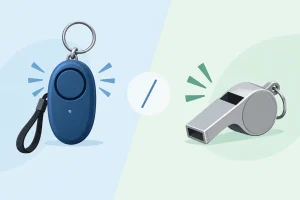
These are among the safest legal bets. Personal alarms and safety lights are generally legal across the US because they are not weapons in the traditional sense. They help attract attention, create confusion, and improve visibility.
They also make sense for people who cannot or do not want to carry chemical sprays or electronic defense tools. The trade-off is that they are deterrence tools, not stopping tools. They can buy time and create an opening to escape, which is often exactly what you need.
Bear spray and dog repellent are legal in many places for their intended purposes, but that does not automatically mean they are approved for everyday human self-defense use. The labeling, spray pattern, and laws around use can matter.
This is an area where people get careless. Carrying bear spray in an urban setting for defense against people may raise legal questions, and the size alone can make it less practical for daily carry. Use products for their intended and lawful purpose.
This is the first checkpoint. One state may allow pepper spray and stun guns with few restrictions, while another may impose age limits, permit requirements, or outright bans on certain tools.
Cities and counties sometimes add stricter rules. This is especially common in large metro areas. If you live near a state line or commute into a city, your legal carry setup at home may not be legal at work.
Many states restrict some self-defense items for minors or for people with certain criminal convictions. This can apply to sprays, electronic devices, and firearms.
A tool might be legal on the street but prohibited in a courthouse, school zone, airport, stadium, or private workplace. These location-based restrictions matter just as much as the item itself.
An item described as a pen, flashlight, or keychain may still be treated as a weapon if its real purpose is obvious. Design matters. So does how a prosecutor or officer may interpret it after an incident.
The strongest self-defense tool is not the most aggressive one. It is the one you can lawfully carry, reach fast, and use under pressure.
That is why pepper spray, personal alarms, and safety lights are often smarter for everyday people than heavier impact weapons. They tend to be more accessible, easier to learn, and less likely to create legal trouble when chosen correctly. If your state allows stun guns and you are comfortable with their limitations, that can also be a solid option.
Think about your daily routine. If you walk to your car at night, a safety light and pepper spray may be a better fit than a baton. If you want a layered setup, pairing a personal alarm with a legal defensive spray can make a lot of sense. The goal is not to look tough. The goal is to get home safe.
Before you purchase anything, check your state statutes, your city rules, and any location-specific restrictions that affect where you spend time. Read product descriptions carefully and avoid assuming that a popular item is legal simply because it is easy to find online.
You should also think beyond legality. Ask whether the item is intuitive, whether you can access it quickly, and whether you are willing to practice with it. A legal tool that stays buried at the bottom of a bag is not doing much for your protection.
For many buyers, the best approach is to start with a practical, affordable option that covers real-world risks without overcomplicating things. That is one reason stores like Elite Warrior Defense focus on everyday security tools people can actually carry and use.
Even if an item is legal, using it must still fit your state’s self-defense laws. In general, force must be reasonable under the circumstances. Threatening someone, escalating a minor argument, or using a defensive tool when there is no real danger can turn a legal product into a legal problem.
Confidence matters, but control matters too. The right self-defense item should help you create distance, stop a threat long enough to escape, and protect yourself without crossing lines you did not know existed. Staying safe starts with preparation, and the smartest preparation is always legal, practical, and close at hand.



YOU’RE IN!
Use this code on every order
🎉
Here’s Your Code!
Use it now an on every future order.
YOUR DISCOUNT CODE
We also sent this code to your email for safekeeping.
EXCLUSIVE OFFER
Every order – not just your first!
Unlock Your Discount Instantly
Enter your email below and your personal 15% discount code appears right here – no need to check your inbox.
🔒 We respect your privacy. Unsubscribe anytime.