
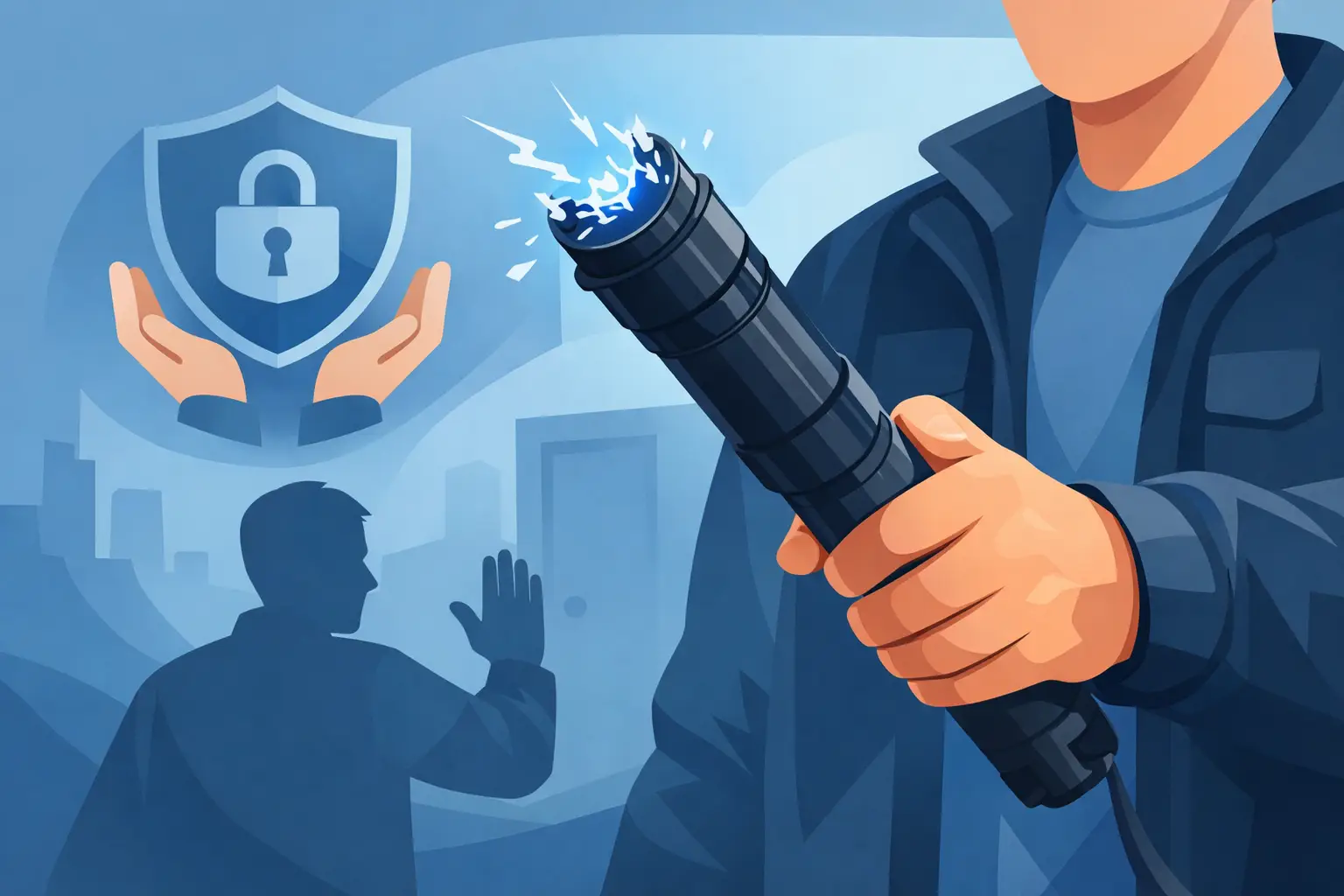
A stun baton can give you reach, deterrence, and a stronger sense of control in a high-stress moment – but only if you know how to use a stun baton safely before you ever need it. This is not the kind of tool you figure out under pressure. Safe use starts long before an emergency, with the right habits, realistic practice, and a clear understanding of what the device can and cannot do.
A stun baton is designed to help you create an advantage when your personal safety is at risk. It can be an effective self-defense option because it adds distance between you and a threat while also delivering an electrical charge meant to disrupt an attacker long enough for you to escape. That said, effectiveness and safety go together. Mishandling the baton, storing it carelessly, or relying on it without practice can put you at greater risk instead of less.
Many people make the mistake of focusing only on the device itself. The real issue is decision-making under stress. If your grip is wrong, the battery is dead, or you do not understand the safety switch, your response time disappears when it matters most. Confidence comes from preparation, not from simply owning the tool.
The first rule is simple: read the product instructions from start to finish. Even if you have owned a stun device before, models vary. Some include a built-in flashlight, some use a trigger-style activation, and others have multiple safety features that prevent accidental discharge.
Take time to identify the power switch, safety mechanism, charging port, wrist strap, and contact points. You should be able to operate every basic function in low light without hesitation. If you need to stop and think about how to turn it on, that delay matters.
You should also understand the intended use of your specific baton. A compact model may be easier to carry daily, while a longer baton gives you more stand-off distance. One is not automatically better than the other. It depends on your environment, comfort level, and how consistently you will carry it.
Before carrying any stun device, confirm that it is legal where you live and where you travel. Laws can differ by state, county, or city, and some areas restrict possession, carry methods, or use in certain locations. A self-defense tool only helps you if you can carry it legally and responsibly.
Legal use matters just as much as legal ownership. In general, a stun baton is for self-defense when you reasonably believe you are in danger. It is not for intimidation, horseplay, arguments, or showing off. Using it outside a lawful self-defense situation can create serious legal consequences.
Safe handling starts in a controlled setting. Before you carry the baton in public, practice with it at home in a private area away from children, pets, and anyone who could be startled or harmed.
Begin by learning the feel of the baton in your hand. Practice drawing it from wherever you plan to keep it, whether that is a bag, vehicle compartment, or bedside location. Your grip should be firm, with the baton oriented correctly from the start. Fumbling is common when people only practice once or twice.
Do not repeatedly test-fire the unit for long bursts just because you want to hear or see it work. Brief function checks are usually enough, following the manufacturer’s instructions. Excessive test firing can drain the battery and reduce readiness. The point is to confirm operation, not to waste charge.
Storage matters, too. Keep the baton in a secure place that is easy for you to access but not available to unauthorized users. If there are children in the home, treat the device with the same level of seriousness you would give any defensive tool. Locked, controlled storage is the safer choice.
A stun baton is not helpful if the battery is dead. Build a maintenance routine so you are not guessing about its condition. Recharge it on a schedule based on the manufacturer’s guidance, even if you have not used it recently. Battery performance can drop over time when a device sits untouched for months.
Inspect the baton regularly for cracks, loose parts, damaged prongs, or charging issues. If the flashlight is dim or the activation seems inconsistent, address that before carrying it again. Reliable equipment supports clear decisions. Unreliable equipment creates hesitation.
Carrying a stun baton safely means balancing access with control. If it is buried under loose items in a tote bag, you may not reach it in time. If it is carried carelessly with the safety off, you increase the chance of accidental activation or fumbling.
Choose a carry method you can repeat every day. Consistency matters. A baton that is comfortable to carry and easy to retrieve is far more useful than one that feels secure in theory but stays at home most of the time.
Keep your awareness up when moving through parking lots, walking to your door at night, or entering unfamiliar spaces. A stun baton should support good safety habits, not replace them. Your first line of defense is still awareness, distance, and early action. If something feels wrong, change direction, get to a safer area, or call for help before the situation closes in.
If a threat becomes immediate, your goal is not to stand your ground longer than necessary. Your goal is to stop the attack long enough to get away. That mindset helps you use the tool more safely and more effectively.
Start with verbal commands if there is time and distance. A clear, strong command such as “Back up” or “Stay away” can sometimes create hesitation or attract attention from others nearby. In some cases, the visible presence and audible arc of a stun baton may deter an aggressor before physical contact happens. In other cases, it may not. Never assume display alone will end the threat.
If physical use becomes necessary, focus on creating an opening to escape. Follow the instructions for your specific model and use only the amount of force that is reasonable for the threat you are facing. Once you have the chance to disengage safely, move. Do not stay to continue the confrontation if escape is possible.
A stun baton is not a magic solution. Heavy clothing, body position, movement, and stress can affect how any defensive tool performs in real life. That is why situational awareness and follow-up action are so important.
It is also not a substitute for judgment. If you are dealing with multiple attackers, close confinement, or someone armed with a more dangerous weapon, your safest move may be to create distance and escape rather than trying to close in. Self-defense always depends on the moment.
Never use a stun baton on someone who is not an active threat. Never use it as a prank. Never handle it casually around friends or family. The safest users are the ones who treat the tool with discipline every time.
The best practice is calm, simple, and repeatable. Rehearse accessing the baton, switching off the safety, establishing your grip, and moving to a safer position. Do this slowly first. Speed comes later.
You can also practice verbal commands and movement. For example, step back, create an angle, and give a loud instruction. This helps connect the baton to a broader self-protection response instead of treating it like a stand-alone fix.
What you should not do is build false confidence from casual handling. Spinning the baton, waving it around, or testing it unnecessarily does not make you more prepared. It makes you less disciplined. Real readiness looks controlled, not dramatic.
If you use the baton in a real incident, get to safety first and contact law enforcement as appropriate. Report what happened clearly and calmly. If you were injured or feel shaken, seek medical attention and support.
Afterward, inspect the baton and recharge or replace it if needed. A defensive event is also a chance to review what worked and what did not. Maybe your carry position was too slow. Maybe you realized your flashlight mattered more than you expected. Those lessons are valuable because they improve your readiness going forward.
Learning how to use a stun baton safely is really about building dependable habits. The baton matters, but your mindset matters more. Safe storage, legal awareness, routine charging, realistic practice, and clear decision-making all work together.
At Elite Warrior Defense, we believe personal security should feel empowering, not intimidating. The right self-defense tool can help you protect your space and your peace of mind, but only when you respect it enough to prepare with purpose. Carry it responsibly, practice with intention, and let confidence come from being ready – not from taking chances.


YOU’RE IN!
Use this code on every order
🎉
Here’s Your Code!
Use it now an on every future order.
YOUR DISCOUNT CODE
We also sent this code to your email for safekeeping.
EXCLUSIVE OFFER
Every order – not just your first!
Unlock Your Discount Instantly
Enter your email below and your personal 15% discount code appears right here – no need to check your inbox.
🔒 We respect your privacy. Unsubscribe anytime.