

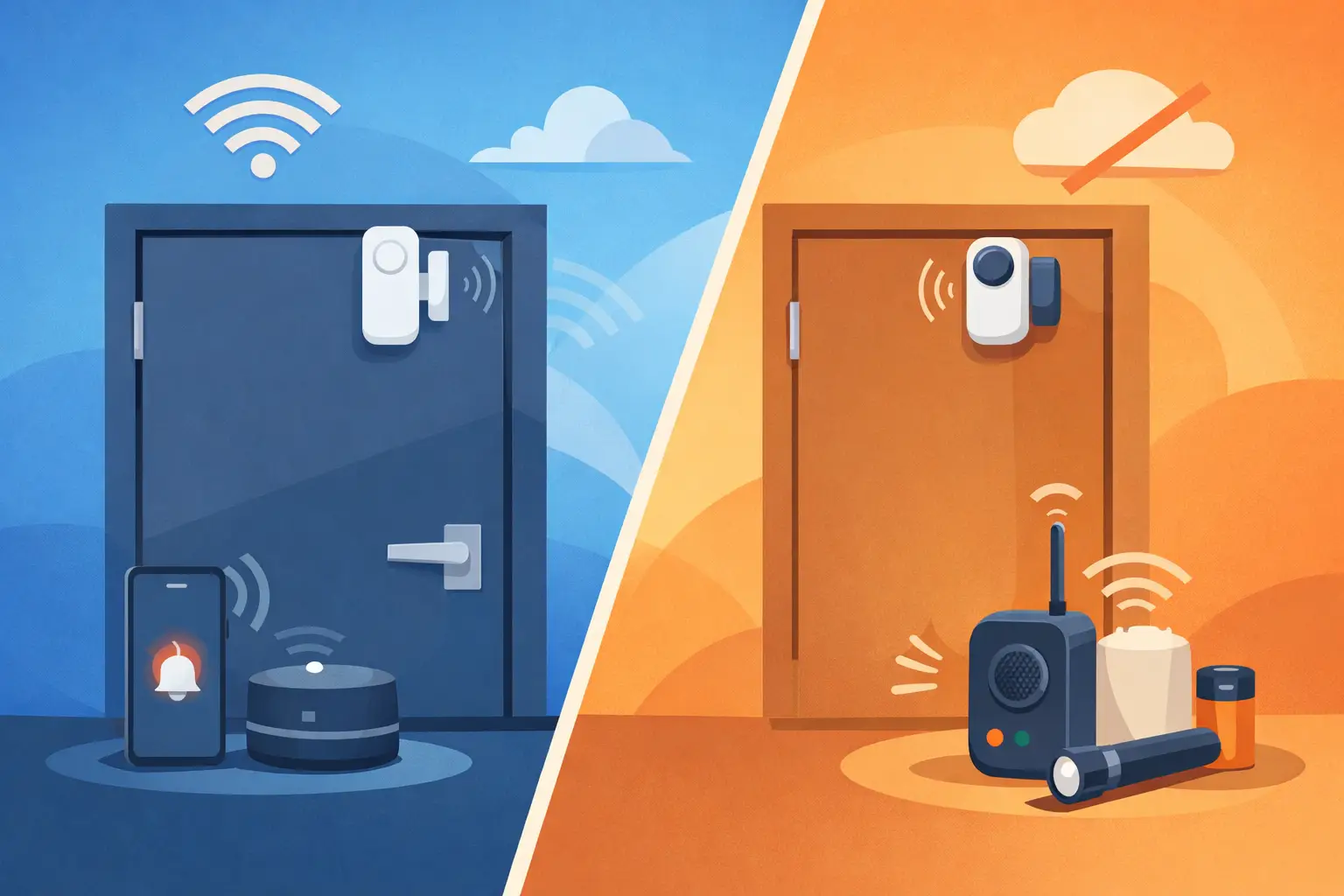
A door opens when it should not. That is the moment an alarm needs to do its job – not after an app reconnects, a router resets, or the internet comes back online. So, do door alarms need WiFi? No. Many of the most practical door alarms work completely without WiFi and provide immediate, loud protection right at the entry point.
WiFi can add useful remote features, especially when you are away from home. But it is not the same thing as security, and it is not required for a door alarm to detect an opening or sound a siren. The right choice depends on where you need protection, who needs to hear the alert, and what will still work during an outage.
No. A basic door alarm can work as a self-contained device with a battery, a magnetic contact sensor, and a built-in siren. One piece mounts to the door and the other to the frame. When the door opens and the magnetic connection separates, the alarm sounds.
This type of alarm does not need an internet connection, a smartphone, an account, or a monthly subscription. It is a direct, local warning designed to make noise immediately. That makes it a strong option for front doors, back doors, apartment entries, garage access doors, dorm rooms, hotel rooms, storage areas, and ground-floor windows.
For many households, the simplicity is the advantage. A loud alarm can alert people inside the home, draw attention to an attempted entry, and pressure an intruder to leave quickly. It also gives you protection when WiFi is unavailable or unreliable.
WiFi-enabled door alarms work differently. They still use a sensor to detect an opening, but they connect to your home network so they can send an alert to a phone, trigger other smart devices, or report activity through an app. Those features are helpful, but they introduce more moving parts: internet service, router coverage, app permissions, account access, and power for your network equipment.
WiFi is valuable when local noise alone is not enough. If you are at work, traveling, or checking on a second property, a phone notification can tell you that a door has opened. Some systems also allow you to review activity history, name individual sensors, or create automations such as turning on lights when a door opens.
That added awareness can be useful for families with children, caregivers monitoring an older relative, or homeowners who want to know when someone enters a rarely used door. A WiFi system may also connect with indoor cameras, smart locks, or a larger home security setup.
Still, a WiFi notification is only as dependable as the connection behind it. If your router loses power, your internet service goes down, or the alarm is installed at the edge of weak coverage, you may not receive the alert when you need it. A phone on silent, a drained battery, or a disabled notification setting can create another gap.
A smart alarm is not automatically a better alarm. It is better only when its remote features solve a real need and you are willing to maintain the system.
An offline alarm is often the right answer when your priority is immediate deterrence. It does not wait to communicate with a server or depend on anyone checking a phone. Once armed, it detects the opening and sounds.
That makes standalone alarms especially practical in situations where setup needs to be fast and uncomplicated. Renters may not be able to install a permanent security system. College students may need extra security in a dorm or temporary housing. Travelers may want a portable alarm for a hotel room. A homeowner might simply want another layer of warning on a side door that is not used often.
Offline models also make sense as a backup. Even homes with professionally installed smart security systems can benefit from local alarms on vulnerable entry points. If there is a power outage or a network issue, a battery-powered alarm can continue protecting that door.
The trade-off is straightforward: if nobody is close enough to hear it, you may not know it activated. A local siren can still discourage an intruder, but it cannot notify you across town on its own.
Choose a WiFi-connected option when remote awareness matters as much as the audible alarm. If you want an alert while you are away, want to monitor when kids arrive home, or need to check activity at a vacation property, WiFi features can be worth the extra setup.
Before relying on one, confirm that the door has a strong, stable signal. A sensor at a detached garage, basement entrance, or exterior gate may be too far from the router. Also consider what happens during a power failure. Many people assume their WiFi continues working because the sensor has batteries, but the modem and router usually need power too. A battery backup for network equipment can help, though it is another piece of equipment to manage.
For the strongest setup, avoid treating WiFi and local alarms as competing choices. A connected alarm with a loud onboard siren gives you both immediate noise at the door and a remote alert when the network is available. That layered approach provides more protection than relying on a phone notification alone.
Security product descriptions can make connectivity sound more confusing than it is. Knowing the difference helps you choose with confidence.
A WiFi door alarm uses your home internet connection to send notifications or connect to an app. It is convenient for remote monitoring, but depends on your network.
A Bluetooth alarm usually connects directly to a nearby phone. It may be useful for setup or close-range control, but Bluetooth generally will not notify you when you are miles away unless the system uses another connection.
A cellular security system uses a cellular network rather than your home WiFi to communicate. These systems can be more dependable during an internet outage, although they commonly require a service plan and may have higher upfront or ongoing costs.
A wired alarm receives power and sometimes communication through physical wiring. Wired systems can be very dependable, but installation is more involved and may not be suitable for renters or quick upgrades.
A simple battery-powered magnetic door alarm is often the most accessible option because it remains independent of all four. It is not meant to replace every larger system, but it can provide meaningful protection where you need it most.
Start with the question that matters most: who needs to know when this door opens? If the answer is someone inside the home, an offline siren alarm may be all you need. If the answer is you while you are away, look for a connected system that provides remote alerts as well as an audible alarm.
Next, consider the door itself. Check whether the sensor can be mounted so its two pieces line up properly when the door is closed. Look at the frame material, the available surface area, and whether the door swings in or out. Sliding doors, French doors, and metal frames may require a different placement or style of sensor.
Volume matters, too. An alarm should be loud enough to be heard in the areas where you expect someone to respond. For a detached shed or remote garage, a local siren is still a deterrent, but it may need a connected alert or additional security layer if you cannot hear it from the house.
Finally, think about maintenance. Battery-powered models need periodic battery checks. WiFi models need both battery checks and connection checks. Test any alarm after installation, then test it routinely. A device that has never been tested is not a security plan.
Even a good alarm can fail to deliver if it is mounted carelessly. Clean and dry the mounting surface before attaching adhesive-backed sensors. Position the two magnetic pieces close together according to the product instructions, and make sure the door can open without knocking them loose.
Install alarms where an unauthorized opening matters most: exterior doors, doors leading from garages into the home, patio doors, basement entries, and accessible windows. Consider interior doors only when there is a specific concern, such as protecting a home office, medicine cabinet area, or private storage room.
Keep the alarm accessible enough to arm, disarm, and test, but not so exposed that it can be easily removed from outside. If children or guests use the door often, make sure trusted people understand how the alarm works. Security should strengthen your routine, not create confusion during an emergency.
Elite Warrior Defense believes practical protection should be accessible, not complicated. A straightforward door alarm can be a powerful part of a larger safety plan when it is chosen for the right job and checked regularly.
The best door alarm is not necessarily the one with the longest feature list. It is the one that will be armed, heard, maintained, and ready when an unexpected opening turns into a moment that demands attention.






YOU’RE IN!
Use this code on every order
🎉
Here’s Your Code!
Use it now an on every future order.
YOUR DISCOUNT CODE
We also sent this code to your email for safekeeping.
EXCLUSIVE OFFER
Every order – not just your first!
Unlock Your Discount Instantly
Enter your email below and your personal 15% discount code appears right here – no need to check your inbox.
🔒 We respect your privacy. Unsubscribe anytime.