

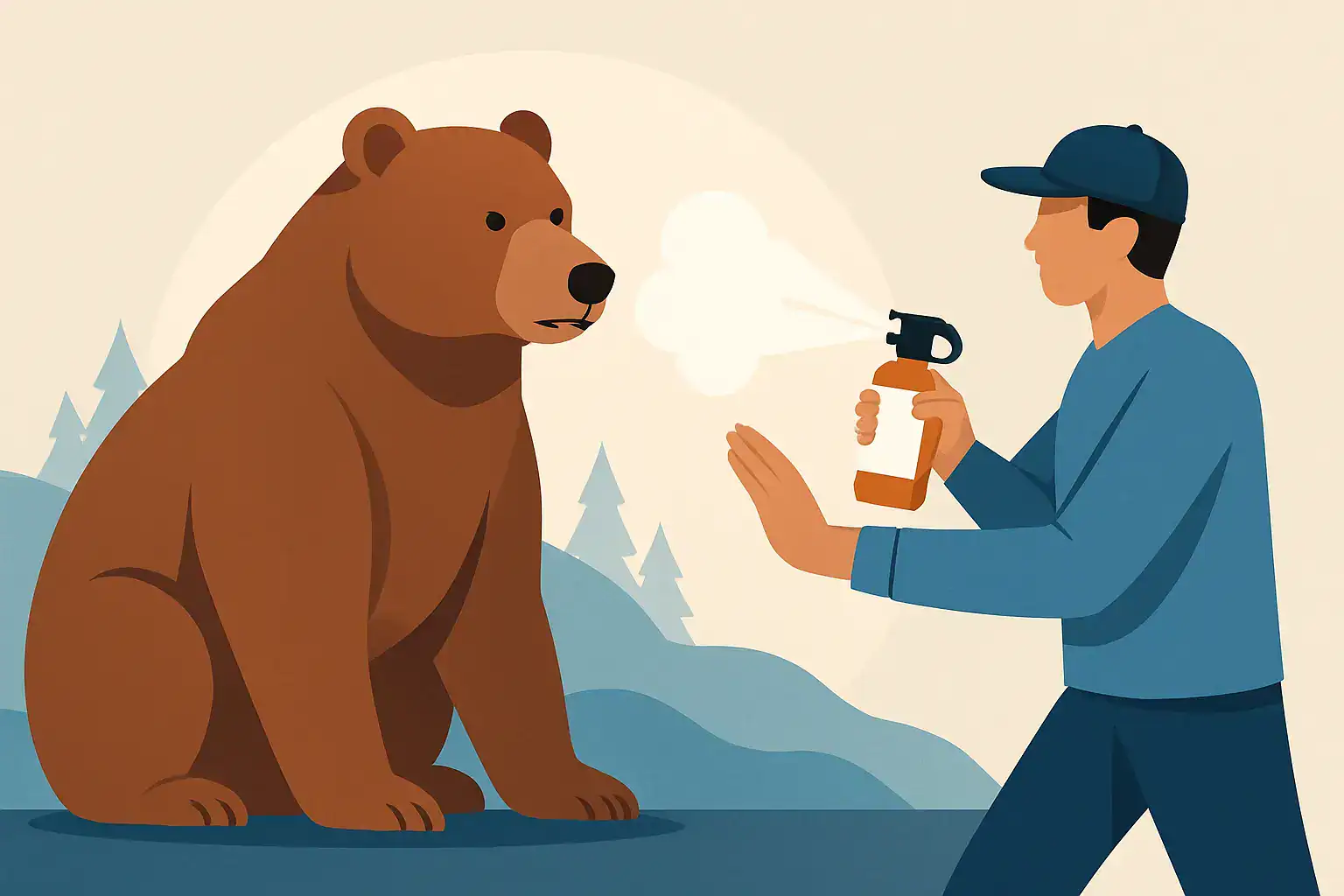
You don’t get a warning shot with a bear. If a bear closes the distance fast, you have seconds to do the right thing with the right tool – and a lot of people find out too late that what they bought, packed, or planned won’t perform under pressure.
“Bear repellent” gets used as a catch-all term, but not every product marketed for the outdoors is designed to stop a charging bear. This guide breaks down what truly works, what’s mostly false confidence, and how to use bear spray correctly so you’re not improvising when it matters.
In real-world terms, bear repellent is any method meant to prevent a bear encounter from turning into contact. That includes deterrents (things that keep bears away), de-escalation (your behavior), and last-resort tools (what you deploy if the bear keeps coming).
The most proven last-resort option for most civilians is bear spray – a high-volume capsaicin spray formulated to create a dense cloud between you and the bear. It’s not about “hurting” an animal. It’s about overwhelming the bear’s senses long enough for it to break off and for you to leave safely.
Other items can support that goal, but they’re not equal substitutes. Some are prevention tools. Some are noise makers. Some are wishful thinking.
A smart bear plan uses both.
Deterrence is what reduces the odds you’ll ever need to deploy anything: food storage, campsite hygiene, managing scent, and making yourself known on trails where visibility is limited. Emergency defense is what you rely on if a bear ignores deterrence or you surprise each other at close range.
A common mistake is treating deterrence tools as emergency tools. For example, odor-reducing bags, “animal repellent” sprays meant for raccoons, or gimmick ultrasonic devices might help in specific low-stakes scenarios, but they are not built for a moving, determined bear at short distance.
If you’re choosing one dedicated bear repellent for backcountry travel, bear spray is usually the best place to start. It’s designed for bear behavior and bear speed.
A few performance points matter more than marketing:
You’re trying to create a barrier, not paint a target. A longer effective range gives you more time to react and more space to back away. Duration matters because you may need a sustained burst to build a cloud, adjust for wind, and continue coverage if the bear keeps advancing.
Many bear sprays are engineered to project a wide cone or fog that expands into a wall. That helps under stress, because perfect aim is not realistic when something large is moving fast.
A can in your pack is basically a can you don’t have. The best bear repellent is the one you can deploy immediately.
Carry it where your hands naturally go: a belt holster, chest holster, or a pack strap holster. If you have to dig, unzip, and fumble, the encounter will already be on top of you.
Most failures with bear spray happen before a bear is even involved. People pack it like a snack instead of treating it like emergency equipment.
Keep it on your body, not in a backpack. If you’re hiking with a partner, each person should carry their own. If one person has it and they get separated, the other person has nothing. If you’re fishing or doing camp chores, the spray should still be within reach – bears don’t schedule visits around your convenience.
Practice the draw with the safety on. You’re building muscle memory: grab, orient, thumb the safety, present forward. Do it enough that your hands can do it while your brain is catching up.
Bears are not all the same, and neither are encounters. A bear that’s far away and moving on is not your cue to spray. Spraying too early can waste your only defensive tool and can even increase risk if you create chaos or attract attention without a real need.
Use your judgment based on distance, speed, and behavior.
If a bear is at a distance, aware of you, and not approaching, give it space. Back away calmly, avoid sudden movements, and don’t run.
If a bear is approaching, closing distance, or showing signs of agitation or intent, you’re moving toward “ready position.” Get the can in hand, prepare your stance, and create distance.
If a bear charges or continues a direct approach inside close range, that’s when bear spray becomes an emergency tool – you deploy to create a barrier and then you get out.
You don’t need fancy technique. You need a simple plan you can execute when your heart rate spikes.
Plant your feet, slightly staggered. Keep your support hand free for balance. You’re not trying to “win” a fight – you’re trying not to get knocked down.
A bear’s head is low and forward in a charge, and wind can lift spray. Aim slightly downward so the cloud rises into the bear’s path. Think “wall” not “bullseye.”
Spray in controlled bursts as the bear closes, adjusting for wind and movement. If the bear hits the cloud, many will turn away. If it keeps coming, continue building that barrier and prepare to move out of the area the moment the bear breaks off.
The goal is separation. Once the bear disengages, you leave. Don’t approach to “see if it worked.” Don’t chase it. Don’t hang around taking photos.
Bear spray is powerful, but it’s not magic.
Wind can push spray back at you. That doesn’t mean it’s useless – it means you must angle and position yourself to avoid a face full of your own repellent. If possible, move laterally so the wind isn’t in your face.
Heavy rain can reduce how long the cloud hangs in the air. Tight terrain can limit your ability to back away. Dense brush can create sudden close encounters where your reaction time is your biggest problem.
That’s why deterrence behaviors matter. Your best bear repellent is still distance and awareness.
Noise can help reduce surprise encounters, especially in thick brush or near loud streams. An air horn can be useful as a deterrent at distance, and it can help signal other people.
But noise is not a reliable stop button for a charge. Some bears ignore it. Some habituated bears in high-traffic areas may barely react.
Ultrasonic devices and generic “animal repellent” sprays are where people spend money for peace of mind, not performance. If it’s not designed and labeled for bears, don’t treat it as bear repellent for emergency defense.
This topic gets emotional. The practical reality is that firearms require skill, legal compliance, secure carry, and calm execution under extreme stress. In many outdoor situations, those conditions aren’t guaranteed.
Bear spray is typically easier to deploy effectively for the average person, has less risk of over-penetration or missed shots, and can be used at very close distances without the same precision demands.
That said, laws and regulations vary by state and by park or wilderness area. Your job is to know what’s legal where you’re going and what you can actually use competently.
If you want to compare defensive tools more broadly, read our breakdown of What Is the Best Self Defense Method? – because the “best” tool is the one you can deploy safely, legally, and fast.
Bear spray is a pressurized canister. Treat it like emergency equipment.
Don’t leave it baking in a hot car for long periods. Don’t store it where kids can access it. Check the expiration date and replace it before it becomes a question mark.
Also, know the difference between “practice” canisters (often inert) and live canisters. Practicing with an inert trainer is smart. Accidentally packing an inert can for the backcountry is not.
Most bear incidents start with food and surprise. Prevention is not glamorous, but it is effective.
In camp, keep a clean site and manage anything with scent. On the move, talk with your group in low-visibility areas and avoid wearing headphones so you can hear movement. If you’re in known bear country, plan your route and timing so you’re not hiking at dusk through dense cover with limited sight lines.
These habits don’t replace bear spray. They make it far less likely you’ll ever need it.
You don’t need to overcomplicate the purchase, but you do need to avoid the common traps: too small, too hard to access, or not actually bear spray.
Choose a canister size that gives a realistic spray duration, prioritize an easy-to-carry holster, and pick a design you can operate with cold hands. If you hike with family, don’t assume one can is enough. Build redundancy the same way you would with first-aid supplies.
If you’re already building a personal safety setup for travel and everyday protection, you can find practical defensive tools and accessories at Elite Warrior Defense. Just keep the categories straight: bear spray is for bear country, and everyday pepper sprays are built for human threats.
A final reality check: bear repellent is not a substitute for respect. Carry the right tool, carry it where you can reach it, and let smart habits do most of the work so you only rely on spray when there’s truly no other option.





YOU’RE IN!
Use this code on every order
🎉
Here’s Your Code!
Use it now an on every future order.
YOUR DISCOUNT CODE
We also sent this code to your email for safekeeping.
EXCLUSIVE OFFER
Every order – not just your first!
Unlock Your Discount Instantly
Enter your email below and your personal 15% discount code appears right here – no need to check your inbox.
🔒 We respect your privacy. Unsubscribe anytime.