
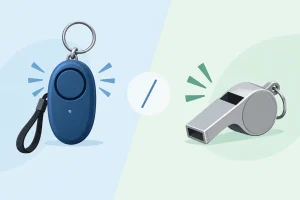
A bad situation does not give you much time to think. If someone is closing distance fast in a parking lot, on a trail, or outside your apartment, your self-defense tool has to be simple, fast, and realistic for the way you actually live. That is why the personal alarm vs pepper spray question matters. Both can help protect you, but they work in very different ways, and the right choice depends on your environment, comfort level, and local laws.
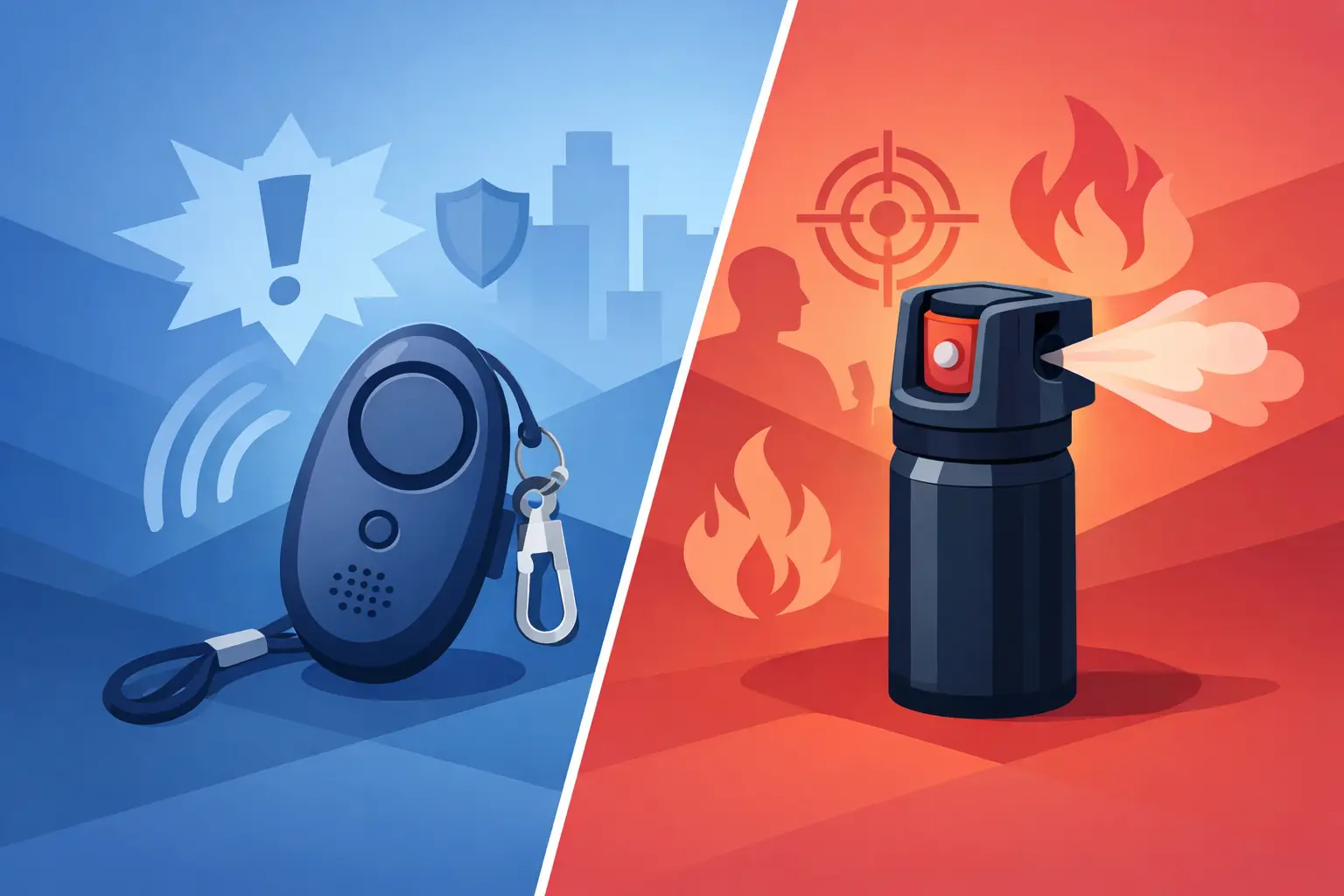
A personal alarm is designed to draw attention. With the press of a button or pull of a pin, it releases a very loud sound meant to startle an attacker and alert people nearby. Its strength is disruption. It can create a moment to run, get help, or make an aggressor think twice.
Pepper spray is designed to physically impair an attacker for a short time. A properly deployed spray can cause intense burning, coughing, eye closure, and disorientation. Its strength is direct stopping power at close range.
That difference matters. A personal alarm depends on noise, attention, and the possibility that others are close enough to hear and respond. Pepper spray depends on accuracy, timing, and your ability to use it under pressure. One calls for help. The other creates a physical barrier.
Neither is automatically better in every scenario. The strongest choice is the one you are most likely to carry, understand, and use correctly.
A personal alarm is often the easiest self-defense tool for everyday carry because it asks very little of the user. There is no spray pattern to learn, no concern about blowback, and in many places, fewer legal restrictions than chemical deterrents. For teenagers, college students, runners, older adults, and anyone who wants a low-barrier option, that simplicity is a major advantage.
It also shines in places where using a chemical agent may be impractical or prohibited. Apartment hallways, public transit platforms, office parking lots, and crowded sidewalks can all be situations where a loud alarm helps create witnesses immediately. In some cases, that public attention is exactly what an aggressor wants to avoid.
There is also a strong psychological benefit. Some people are not comfortable carrying a more force-oriented tool. A personal alarm gives them a protective option they are more likely to keep on a keychain, in a purse, or clipped to a bag. A tool you carry every day usually beats a more powerful tool left at home.
Still, a personal alarm has clear limits. If nobody is around, the value drops fast. If an attacker is determined, intoxicated, or simply willing to ignore the sound, the alarm may buy only a few seconds. It is best understood as an alert-and-escape device, not a guaranteed stop.
Pepper spray is often the stronger option when you may need to actively stop someone long enough to escape. It gives you a way to affect an attacker before physical contact happens, which is a serious advantage. Distance matters in self-defense. Even a few feet can mean the difference between getting away and getting grabbed.
For solo commuters, shift workers walking to their cars at night, delivery drivers, hikers, and anyone moving through low-traffic areas, pepper spray can provide more control than a noise-based tool. It does not rely on bystanders. It relies on your ability to access it quickly and aim effectively.
That said, pepper spray is not magic. It has to be legal where you live and legal for you to carry. You also need to know how your specific canister works. Under stress, people fumble. Safety caps, finger placement, and spray range are small details until they are not. Wind can also become a problem outdoors, and in tight indoor spaces, there is always a risk of affecting yourself.
Pepper spray requires more commitment than a personal alarm. You should practice drawing it, understand its range, and know what to expect after use. If you are not willing to train even a little, you may not get the full benefit of carrying it.
People often frame this as loud vs strong, but the real comparison is broader.
A personal alarm is usually more beginner-friendly. It is also more socially comfortable for people who want a visible safety measure without carrying something that feels confrontational. If your main concern is attracting attention during suspicious encounters, harassment, or attempted intimidation, an alarm can be a smart first line of defense.
Pepper spray is more intervention-focused. If your concern is being cornered, followed into a stairwell, approached at your car, or confronted in a place where help may not come quickly, spray offers a more direct response.
There is also the issue of confidence. Some people feel safer with pepper spray because it can incapacitate. Others feel more confident with an alarm because they know they will actually use it. Confidence matters, but only when it is backed by realism. A tool should match your habits, your physical comfort, and the situations you are most likely to face.
Your daily routine should influence your choice more than internet debates do.
If you spend most of your time in busy public spaces, on campus, in shopping areas, or around coworkers and neighbors, a personal alarm has more value because there are people nearby to hear it. It can quickly turn a private threat into a public situation.
If you regularly walk alone at night, park in dim lots, travel early in the morning, or move through isolated areas, pepper spray tends to offer stronger practical protection. In those moments, outside help may be too far away to count on.
For runners and walkers, the answer can go either way. Some prefer a lightweight alarm because it is easy to activate while moving. Others prefer pepper spray because encounters with aggressive people or even dogs may require more than noise. The best fit depends on route, lighting, and how isolated the area is.
For older adults or people with limited hand strength, ease of activation is critical. Some alarms are very simple to trigger, which makes them appealing. On the other hand, some pepper spray designs are compact and user-friendly enough to work well if the carrier practices with them. Hand size, grip, and carry method all matter here.
Before carrying pepper spray, check your state and local rules. Laws can vary on size, strength, age restrictions, and where you can bring it. That is not a reason to avoid it. It is a reason to be responsible.
Personal alarms are generally easier from a legal standpoint, but practical restrictions still exist in some workplaces, schools, and secured facilities. If you move through controlled environments often, that may influence your decision.
Storage matters too. A self-defense tool buried at the bottom of a bag is not doing much for you. Whether you choose an alarm or spray, it should be accessible in seconds. That usually means keychain carry, clip carry, or a dedicated pocket.
For many people, the smartest answer is yes. A personal alarm and pepper spray are not direct substitutes as much as complementary tools.
An alarm can help at the suspicion stage, when someone is following too closely, harassing you, or creating fear but has not yet closed in. Pepper spray can help at the action stage, when distance is shrinking and a direct deterrent may be necessary. Together, they give you more than one option, which is valuable because real encounters do not follow a script.
This layered approach is one reason many safety-minded customers build everyday carry around simple, reliable tools rather than one all-purpose item. A company like Elite Warrior Defense appeals to that mindset because practical protection works best when it fits real life, not fantasy scenarios.
Ask yourself three honest questions. Where am I most often when I feel vulnerable? Am I willing to practice with my tool? Do I want to alert others, stop an attacker, or both?
If you want the simplest possible safety tool, spend a lot of time around other people, or need an option that feels easy to carry every day, a personal alarm is a strong choice. If you want more direct stopping power and are willing to learn how to use it correctly, pepper spray is often the better pick.
If your lifestyle includes a mix of public and isolated settings, carrying both is often the most balanced move. The goal is not to win a debate about gear. The goal is to give yourself a real chance to react fast, create space, and get home safe.
The best self-defense tool is the one that fits your life closely enough that you carry it every time, trust it under pressure, and can reach it before panic takes over.

YOU’RE IN!
Use this code on every order
🎉
Here’s Your Code!
Use it now an on every future order.
YOUR DISCOUNT CODE
We also sent this code to your email for safekeeping.
EXCLUSIVE OFFER
Every order – not just your first!
Unlock Your Discount Instantly
Enter your email below and your personal 15% discount code appears right here – no need to check your inbox.
🔒 We respect your privacy. Unsubscribe anytime.