

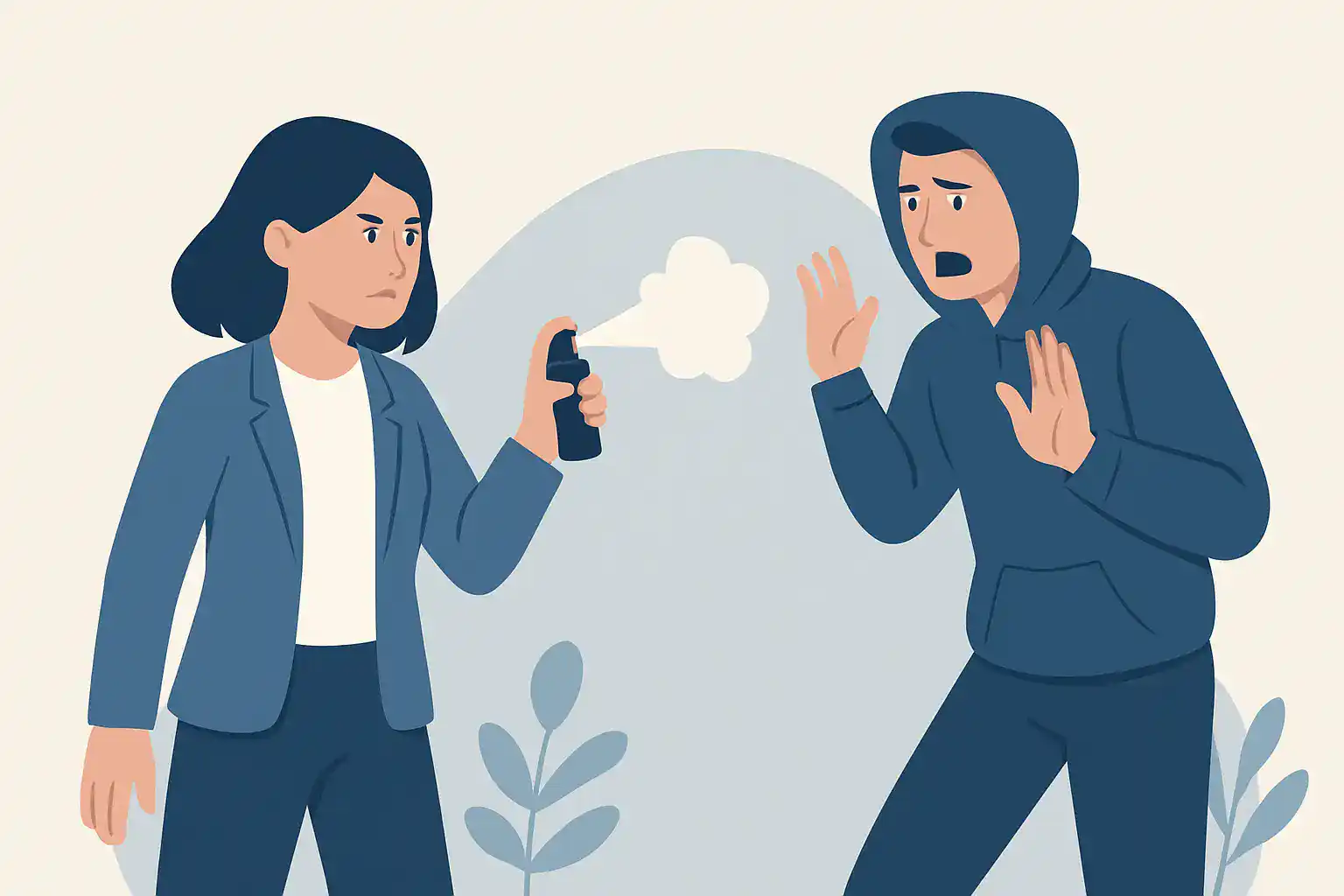
You don’t get a warning bell before a threat shows up. It’s usually fast, close, and loud—your heart spikes, your hands shake, and fine motor skills drop. That’s exactly why pepper spray can be such a strong self-defense tool: it doesn’t require you to be bigger, stronger, or “ready to fight.” But it only helps if you can deploy it quickly and decisively.
This is a practical guide to how to use pepper spray effectively—the way people actually carry it, draw it, fire it, and escape when it counts.
Pepper spray is not a magic force field, and it’s not a tool for teaching someone a lesson. Its job is simple: create a window of time to get away. When it works well, it disrupts breathing and vision, triggers intense burning, and buys seconds to sprint to safety, get behind a locked door, or reach help.
That mindset matters because it keeps your decisions clean. If you deploy spray and then hang around to argue, record, or “see what happens,” you’re throwing away the advantage you just created. Spray is for escape.
People get hung up on brands, heat levels, and marketing claims, but the real question is: can you access and fire it under stress? A compact canister that lives buried in a purse pocket can be worse than useless. If you carry spray, set yourself up for success.
Size should match your lifestyle. A keychain unit can be convenient for errands and walking from the car to the store, while a slightly larger canister may be easier to grip and aim, especially with shaky hands. If you have smaller hands or arthritis, prioritize a design that feels secure and simple.
Also pay attention to the safety mechanism. You want something that prevents accidental discharge but doesn’t require a complicated sequence. Under pressure, “two-step” can turn into “no-step.”
If a threat is close, you won’t have time to dig. Effective carry means the spray is accessible with either hand, and you can draw it without staring at it.
On a walk, the best place is often already in your hand, especially in parking lots, stairwells, and poorly lit areas. If that feels awkward, clip it where you can grab it in one motion—like the outside of a bag strap or a dedicated pocket that stays empty except for your spray.
If you keep it in a purse, don’t let it roam. Give it a “home” pocket, oriented the same way every time. Consistency turns panic into muscle memory.
Most people never practice. Then the first time they touch their pepper spray is the worst moment of their lives.
You don’t need to be tactical or dramatic. A few times a week, rehearse the motion: hand to spray, spray to ready position, thumb to actuator. Do it standing, seated in your car, and while holding a phone. That’s real life.
If you want to go one level deeper, buy an inert trainer canister (a practice unit that doesn’t contain OC) and run short drills. The point is to remove friction: no fumbling, no confusion about which direction the nozzle faces, no surprise when you feel the button.
Pepper spray comes in different delivery styles (like stream, cone/fog, gel, or foam). Each has trade-offs.
A stream tends to reach farther and can be more precise, which can reduce blowback risk. A cone/fog is easier to “paint” across a moving face but can drift more in wind. Gel and foam can stick better and reduce airborne spread, but they may take slightly longer to irritate the eyes and airway compared to a fine mist.
The “range” on the label is a best-case scenario. In real conditions—wind, movement, adrenaline—your practical range is often shorter. That’s why distance management matters.
Here’s the part that counts. The best technique is simple and repeatable.
If someone is closing distance and your gut says “no,” start moving. Step offline rather than straight back if you can. Use obstacles—cars, shopping carts, benches—to force them to slow down or change direction.
While you move, get your spray up to a ready position near chest level. You’re not “aiming” like a movie. You’re preparing to fire quickly.
A loud, sharp command can stop a situation from escalating and can also pull attention from bystanders: “Back up!” or “Stay away!” Keep it simple.
If the person keeps closing, you’ve just confirmed intent. Now you’re acting, not debating.
Your target is the face—eyes, nose, mouth area—because that’s where pepper spray delivers rapid disruption. In a dynamic situation, you may not hit the eyes perfectly, and that’s okay. A solid hit to the upper face area can still be effective.
Hold the canister firmly. Extend your arm slightly, but don’t lock your elbow. Keep your other hand up to protect your head and help manage distance.
Don’t dump the whole can. Use short bursts—about a half-second to one second—and reassess. Think “spray, move, spray” rather than one long panic blast.
Short bursts help you conserve product, adjust your aim, and reduce the chance of spraying yourself if the wind shifts. If the attacker turns their head, keep the spray tracking across the face area.
The moment you’ve sprayed, your job is to leave. Don’t stand there waiting for the reaction. Some people fight through it for a few seconds, especially if they’re highly motivated, intoxicated, or mentally impaired.
Run to a populated area, get inside a business, lock a door, get to your car (if that’s truly the closest safe option), and call 911. Tell the dispatcher your location first, then what happened.
Pepper spray is powerful, but it’s not risk-free to use.
If it’s windy, angle your body so the wind is at your back if possible. If you have to spray into the wind, you may still do it—but understand you might get exposure too. Better a controlled, minimal exposure than doing nothing and getting grabbed.
In tight indoor spaces (hallways, elevators, cars), airborne products can affect everyone in the area, including you. Gel or foam styles can reduce floating particles, but any OC can become your problem in a confined space. If you deploy in a car, your next move should be getting out and creating distance fast.
Even with good technique, cross-contamination happens. The key is not to panic.
Blink rapidly, don’t rub your eyes, and get into fresh air. If you have contacts, removing them can help, but only if your hands are clean enough not to grind irritant into your eyes. Flush with cool water when you can. Soap can help on skin, but avoid oily creams—they can trap the irritant.
Expect discomfort. The goal is to keep moving toward safety and help, not to “tough it out” in place.
Pepper spray is a defensive tool. Use it when you reasonably believe you’re facing an imminent threat. Laws vary by state and even by city—some places regulate canister size, concentration, or where you can carry it.
Also consider the real-world consequences even when use is justified: police involvement, statements, and the emotional crash afterward. If you deploy spray, you should be prepared to report the incident clearly and calmly.
Pepper spray is not “buy once, forget forever.” Check the expiration date and replace it on schedule. A weak spray, a clogged nozzle, or a leaking canister is the kind of failure you only discover when it’s too late.
Do a quick monthly check: is the safety intact, is the nozzle clear, does the can feel full, and is it stored at reasonable temperatures? Leaving it in a baking-hot car for weeks can degrade performance over time.
If you’re building a personal safety setup and want a reliable place to start, you can find pepper spray options alongside other practical defense tools at Elite Warrior Defense.
Pepper spray works best when you’re already living in “prevention mode”: head up, phone down, scanning the parking lot, trusting your instincts early. If you wait until someone is within arm’s reach, your options shrink.
Carry it where you can reach it, practice until the draw is boring, and give yourself permission to act fast when something feels wrong. Your safety is worth decisive action—and you don’t owe anyone a second chance to get closer.





YOU’RE IN!
Use this code on every order
🎉
Here’s Your Code!
Use it now an on every future order.
YOUR DISCOUNT CODE
We also sent this code to your email for safekeeping.
EXCLUSIVE OFFER
Every order – not just your first!
Unlock Your Discount Instantly
Enter your email below and your personal 15% discount code appears right here – no need to check your inbox.
🔒 We respect your privacy. Unsubscribe anytime.