

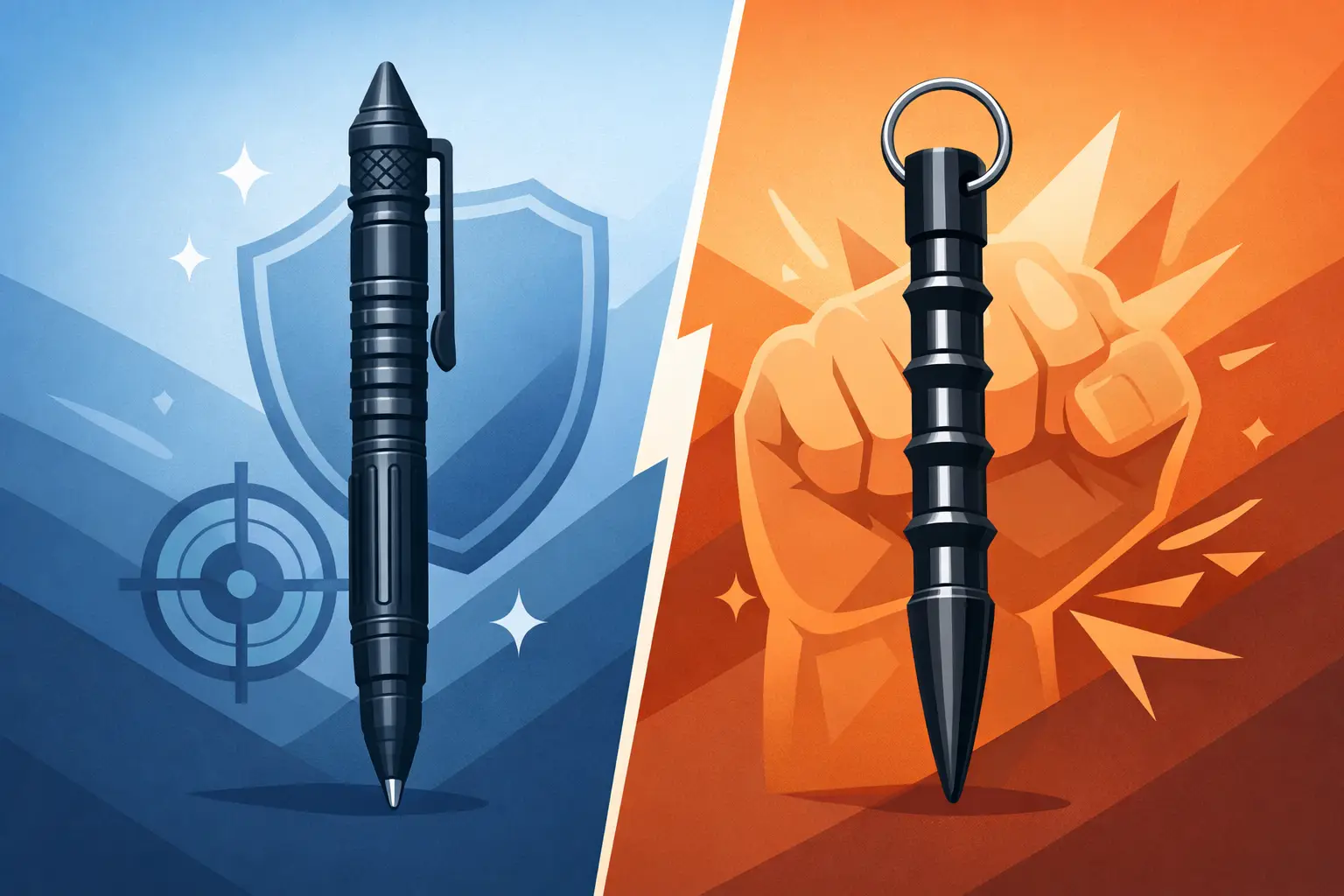
You do not get much warning in a real threat. That is why the tactical pen vs kubotan question matters more than most people think. Both are compact, easy to carry, and built around close-range personal defense, but they are not interchangeable. The right choice depends on how you move through your day, how discreet you need your gear to be, and how much training you are willing to put in.
For many people, the decision starts with one simple reality: the best self-defense tool is the one you will actually carry. A tool left in a drawer has no value when you need it. That makes everyday convenience just as important as striking power, grip, or appearance.
A tactical pen is exactly what it sounds like – a writing pen built with a stronger body, often aluminum or aircraft-grade metal, that can also serve as an emergency and defensive tool. Many include features like a glass breaker, reinforced tip, pocket clip, and a body shape designed for a secure grip.
A kubotan is a compact self-defense stick, usually about the size of a small marker or keychain tool. Its purpose is more direct. It is designed specifically for pressure-point control, leverage, pain compliance, and short-range striking. It does not pretend to be anything else.
That difference shapes everything. A tactical pen blends into normal life because it is still a pen. A kubotan is more purpose-built, more obvious in intent, and often simpler in design.
The biggest advantage of a tactical pen is that it fits into daily life without effort. You can clip it into a pocket, bag, notebook cover, or organizer and keep moving. In professional settings, office environments, or routine errands, it does not attract much attention because it looks like a writing instrument first.
That matters for people who want low-profile preparedness. If you are commuting, working late, walking to your car, or traveling through unfamiliar areas, having a tool that stays on you without creating friction is a real benefit.
A tactical pen also gives you more than one function. You can write with it, use it as an emergency glass breaker, and keep it available as an impact tool if things go bad fast. That kind of practical overlap appeals to people who do not want to load their pockets with single-purpose gear.
There is also a comfort factor. Many people are more willing to carry a tactical pen every day because it feels familiar. It does not require a major lifestyle change.
A kubotan is straightforward. It is made for retention in the hand and close-contact defense. There is no cap to remove, no concern about ink cartridges, and usually no moving parts. That simplicity can be a major advantage under stress.
For someone who wants a dedicated impact tool, a kubotan makes sense. It is compact, durable, and often easy to anchor to a keychain so it is quickly accessible. In a close-range struggle, that secure hold can matter. A kubotan can help concentrate force into a small area and may improve your ability to control or disrupt an attacker at arm’s length.
Another reason some people prefer a kubotan is training style. If you have practiced pressure-point applications, hammer-fist strikes, and grip retention, the kubotan offers a very clean platform for those techniques.
This is where the comparison gets practical fast. A tactical pen usually wins on discretion. It slides into normal routines and does not stand out in a meeting, classroom, or coffee shop. If you need something that travels with you from one setting to another without raising eyebrows, that is a real advantage.
A kubotan can be easy to access too, especially on a keychain, but it may be more visible and more likely to be recognized as a self-defense item. For some people, that is fine. For others, especially those who work in professional or highly public environments, that visibility is a drawback.
Accessibility also depends on how you carry. A pen clipped in a front pocket may be faster to deploy than a kubotan buried in a bag. On the other hand, a kubotan already attached to your keys might be in your hand as you walk to your car at night. Context matters.
If you are judging strictly by defensive intent, the kubotan has a more specialized design. It is built for short, sharp impact and control methods. In trained hands, it can be effective for targeting soft tissue areas, improving leverage, and creating a quick chance to escape.
A tactical pen can also strike effectively, especially with a reinforced point and solid body, but its shape is often slightly narrower and more tied to dual-use design. That does not make it weak. It just means it was built with a broader purpose.
The trade-off is simple. The kubotan may feel more natural as a dedicated defensive tool. The tactical pen may feel more natural as an everyday carry item that can serve a defensive role when needed.
Neither tool is magic. That needs to be said clearly. If someone buys a tactical pen or kubotan and assumes ownership alone equals readiness, they are setting themselves up for disappointment.
Under stress, fine motor skills can drop. Adrenaline changes how you move, think, and react. The person who has practiced drawing the tool, maintaining grip, creating space, and disengaging safely has a major advantage over someone who has only held the product once.
This is one reason the tactical pen appeals to beginners. It feels easy to carry and easy to understand. But a kubotan can also be very effective for beginners if they spend time learning simple, gross-motor movements rather than complicated control techniques.
The smart approach is to keep your expectations grounded. These are force multipliers for close-range defense and escape, not substitutes for awareness, avoidance, or training.
Before carrying either tool, check local and state laws, along with workplace, school, or venue policies. Laws can vary, and what is acceptable in one location may create problems in another.
This is especially relevant in the tactical pen vs kubotan conversation because one item is commonly understood as a pen and the other is more openly associated with self-defense. That does not automatically make one legal and the other illegal. It does mean perception can play a role in certain settings.
If you travel frequently, move through secured buildings, or work in a controlled environment, this point deserves your attention. The smartest self-defense choice is one you can carry confidently and lawfully.
For most adults who want a practical, discreet option, the tactical pen is often the easier everyday carry choice. It blends in, offers utility beyond defense, and works well for people who want readiness without drawing attention.
For those who want a dedicated self-defense tool and are comfortable with a more obvious purpose-built design, the kubotan has strong appeal. It is simple, compact, and direct.
If your day includes office work, appointments, public settings, and routine movement through different environments, a tactical pen may fit better. If your priority is a compact impact tool with no extra features and a simple defensive role, a kubotan may be the cleaner choice.
A tactical pen is a strong fit for someone who values discretion, multi-use design, and all-day carry comfort. It makes sense for commuters, office workers, students in permitted environments, and anyone who wants a self-defense option that can stay in plain sight without drama.
It is also a solid entry point for people building an everyday carry setup. If you are starting with practical security tools and want something accessible, affordable, and useful even when there is no threat, a tactical pen checks a lot of boxes.
A kubotan is better suited for someone who wants a straightforward defensive tool and is willing to practice using it with intention. It can be a good match for those who already carry keys in hand, prefer a compact striking tool, or want a no-frills option focused on close-range defense.
It may also appeal to people who do not care about dual-purpose features. They want a tool for one job, and they want it ready.
There is no universal winner in the tactical pen vs kubotan debate. A tactical pen gives you discretion, daily utility, and strong carry potential. A kubotan gives you dedicated defensive simplicity and a design built around close-contact use.
Confidence comes from matching the tool to your environment, your habits, and your willingness to train. If you choose gear that fits your real routine, you are far more likely to carry it, practice with it, and trust it when the moment gets serious. That is the kind of preparation that actually matters.



YOU’RE IN!
Use this code on every order
🎉
Here’s Your Code!
Use it now an on every future order.
YOUR DISCOUNT CODE
We also sent this code to your email for safekeeping.
EXCLUSIVE OFFER
Every order – not just your first!
Unlock Your Discount Instantly
Enter your email below and your personal 15% discount code appears right here – no need to check your inbox.
🔒 We respect your privacy. Unsubscribe anytime.