

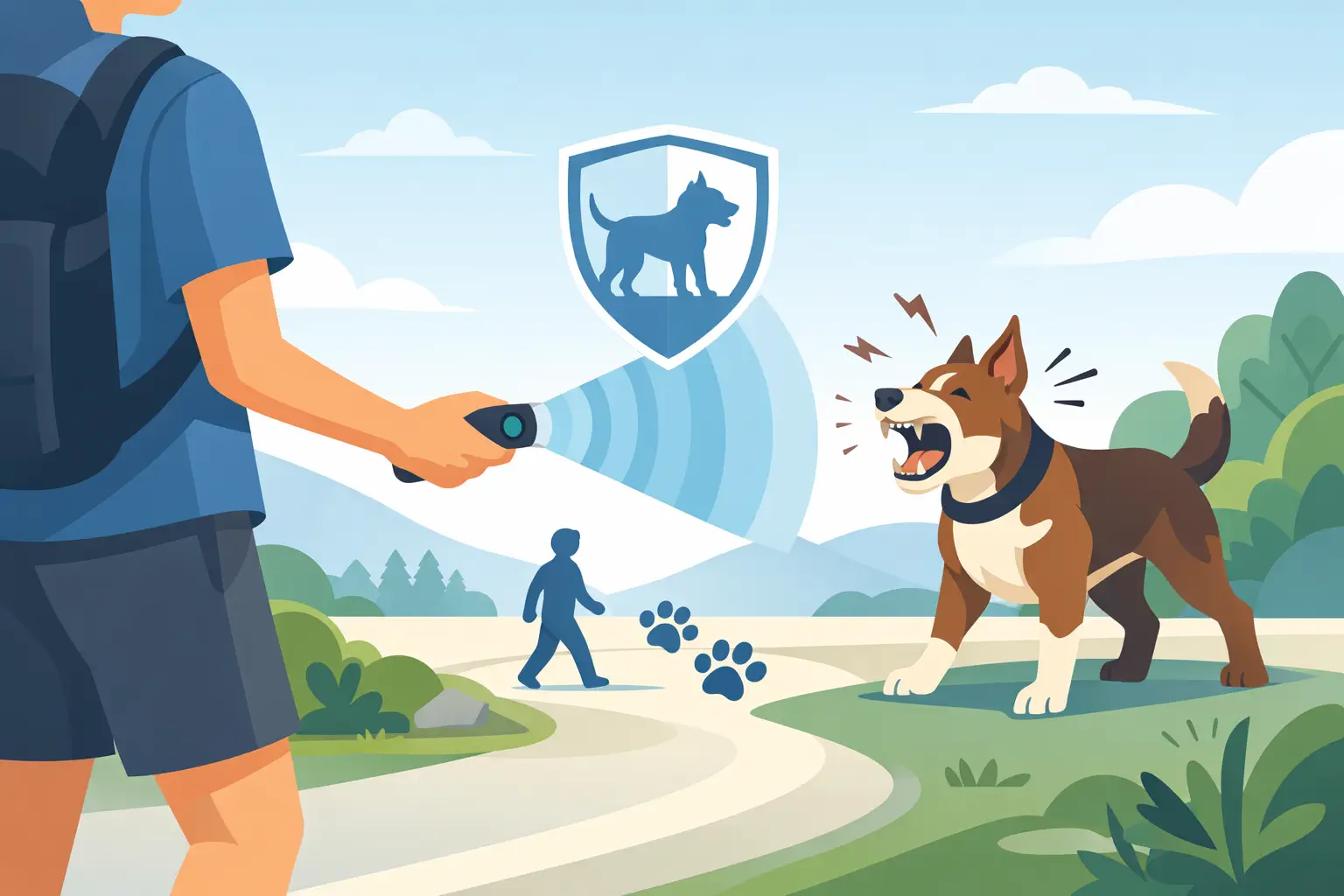
A loose dog can change the tone of a walk in seconds. One moment you are moving through your neighborhood, trail, or park like usual. The next, you are reading body language, creating distance, and deciding whether you need dog repellent for walkers or just better positioning and a firm voice. That decision matters, because the right response can stop a bad situation before it turns into an injury.
For most people, this is not about wanting to hurt an animal. It is about protecting yourself, your child, or your own dog if an unfamiliar dog charges, corners, or refuses to back off. Good preparation gives you options. Better options give you time. And time is often what keeps a tense encounter from becoming a dangerous one.
Most aggressive dog incidents do not begin with a dramatic attack. They start with uncertainty. A dog appears off leash. It begins following too closely. It stiffens, barks, circles, or rushes forward in short bursts. The problem is that walkers often hesitate because they do not want to overreact.
That hesitation is understandable, but it can also narrow your choices. If you wait until a dog is already within arm’s reach, even the best tool becomes harder to use well. A walker who is prepared has a better chance of staying calm, creating space, and using the lowest level of force necessary.
This is where dog repellent for walkers fits into a broader safety plan. It is not magic, and it is not a replacement for awareness. It is one layer of protection that can help stop an advancing dog long enough for you to leave the area safely.
Most dog repellents designed for personal safety use a strong irritant spray to temporarily overwhelm a dog’s senses, especially the eyes, nose, and breathing comfort. The goal is interruption, not punishment. When it works as intended, it breaks the dog’s focus and gives you a window to move away.
That matters because many dog incidents are momentum-driven. A dog gets excited, territorial, or predatory and keeps pressing forward. A repellent can interrupt that pattern fast. But it helps to be realistic. Effectiveness depends on distance, wind, the dog’s level of drive, and how quickly you recognize the threat.
Not every barking dog requires spray. Some dogs posture and stop when challenged with a strong voice and confident stance. Others do not. The key is understanding that a repellent is for the moment when verbal commands, distance, and body positioning are not enough.
If you walk in areas where off-leash dogs are common, carrying a deterrent is simply smart. The same goes for early morning or evening walks, rural roads, apartment complexes with poor leash compliance, and trails where blind corners reduce your reaction time.
People who walk with small children or smaller dogs have even more reason to prepare. A loose large dog can close distance quickly, and smaller companions are often at greater risk during an aggressive encounter. In those situations, having a dedicated tool on your person can make the difference between reacting late and responding with control.
There is also a confidence factor that should not be overlooked. When you know you have a practical option available, you are less likely to freeze. That confidence helps you project authority, and that alone can discourage some dogs from continuing their approach.
The best repellent is the one you can carry comfortably, reach instantly, and use under stress. Bigger is not always better. If a can is too bulky for a pocket, belt clip, or small walking pouch, people tend to leave it at home. A compact unit that stays on you is usually more valuable than a larger one that sits in a drawer.
Ease of access should come first. If you need two hands, several seconds, or perfect conditions to deploy it, that is a problem. Look for a design that is simple to grip, quick to orient, and secure enough that it will not discharge accidentally while you move.
Spray pattern matters too. A focused stream generally gives you more control and better reach, which can be helpful outdoors. A wider fog pattern may be easier to hit with at close range, but it can also increase your chance of blowback in windy conditions. Neither option is automatically best for everyone. It depends on where you walk and how likely wind exposure is in your area.
Range is another practical issue. More distance gives you more reaction time, but only if you can use it accurately. A shorter-range option may still be effective if it is easy to aim and fast to access. Reliability is the non-negotiable part. A self-defense tool should feel dependable every time you carry it.
The first rule is simple: do not wait until the dog is on top of you. If a dog is closing distance in a way that feels threatening, get your repellent in hand early. That does not mean you must use it immediately. It means you are reducing delay if the encounter escalates.
Keep your footing stable and avoid sudden panicked movements if possible. Many dogs respond to motion, and turning to run can trigger pursuit. Face the dog at an angle, create space, and use a firm command such as “No,” “Back,” or “Go home.” If the dog keeps advancing, prepare to deploy.
Aim for the face, especially the eyes and nose area, and then move away. Your goal is not to stand there and assess your work. Your goal is to break contact and leave safely. If you are walking your own dog, focus on creating separation rather than getting pulled into a struggle between animals.
It also helps to think ahead about one-handed use. If you usually walk with a leash, coffee, phone, or stroller, your repellent needs to fit the reality of your routine. Practice drawing it safely at home so your response feels familiar instead of improvised.
A repellent is a strong tool, but it has limits. It may not instantly stop every dog. Highly aroused, determined, or already-contacting dogs can sometimes push through the initial effect for a short period. That is why positioning, awareness, and fast movement after deployment still matter.
Weather can also change the outcome. Wind can reduce accuracy or send irritant back toward you. Rain can affect performance. Tight indoor spaces, crowded sidewalks, and group settings may limit when and how safely you can use a spray product.
There is also the legal side. State and local rules can vary on self-defense sprays, size limits, and where they can be carried. Responsible ownership means knowing the law where you live and where you walk. Carrying a safety tool should increase your confidence, not create avoidable legal problems.
Good walkers build layers of safety. Awareness is the first one. Keep your head up, scan ahead, and notice open gates, poorly fenced yards, and dogs being handled by owners who seem distracted or overmatched. Those small observations often give you precious extra seconds.
Your voice is another tool. A strong, low, direct command can interrupt an approaching dog before it gets too close. It will not work every time, but it is worth using early. Body language matters too. Stay upright, avoid squealing or flailing, and do not crowd the dog’s path if you have room to sidestep and create distance.
If you walk with your own dog, shorten the leash and keep your dog close to your side during an encounter. A tight, tangled scene creates confusion and raises the chance of bites. Calm handling helps you stay more in control, even when the other dog is not.
And then there is placement. A repellent buried in a backpack is not really on standby. Keep it where your hand can find it fast, every single time. Consistency is part of readiness.
The short answer is anyone who walks regularly in areas where leash laws are ignored or poorly enforced. But some people benefit more than others. Solo walkers, seniors, delivery workers, joggers who pass through unfamiliar neighborhoods, and parents walking with kids all have fewer good options if a dog suddenly rushes them.
Smaller adults may also appreciate having a tool that helps create distance without relying on physical strength. The same is true for people recovering from injury or those who simply know they cannot outrun a charging dog. Personal safety is not about pretending every situation can be handled with words alone. It is about recognizing reality and carrying tools that fit it.
That is why practical self-defense companies, including Elite Warrior Defense, focus on everyday carry options that are straightforward, effective, and built for real-life use. The best gear is not chosen for drama. It is chosen because it gives ordinary people a fair chance to protect themselves.
You should be able to enjoy a walk without wondering whether an off-leash dog will turn it into a crisis. Carrying dog repellent for walkers is not about fear. It is about refusing to be caught unprepared when seconds matter. The right tool, paired with awareness and a calm response, gives you a safer margin when an animal crosses the line from nuisance to threat.
If you walk often, think through your routine before the next close call forces the issue. Confidence is stronger when it is backed by preparation.



YOU’RE IN!
Use this code on every order
🎉
Here’s Your Code!
Use it now an on every future order.
YOUR DISCOUNT CODE
We also sent this code to your email for safekeeping.
EXCLUSIVE OFFER
Every order – not just your first!
Unlock Your Discount Instantly
Enter your email below and your personal 15% discount code appears right here – no need to check your inbox.
🔒 We respect your privacy. Unsubscribe anytime.