

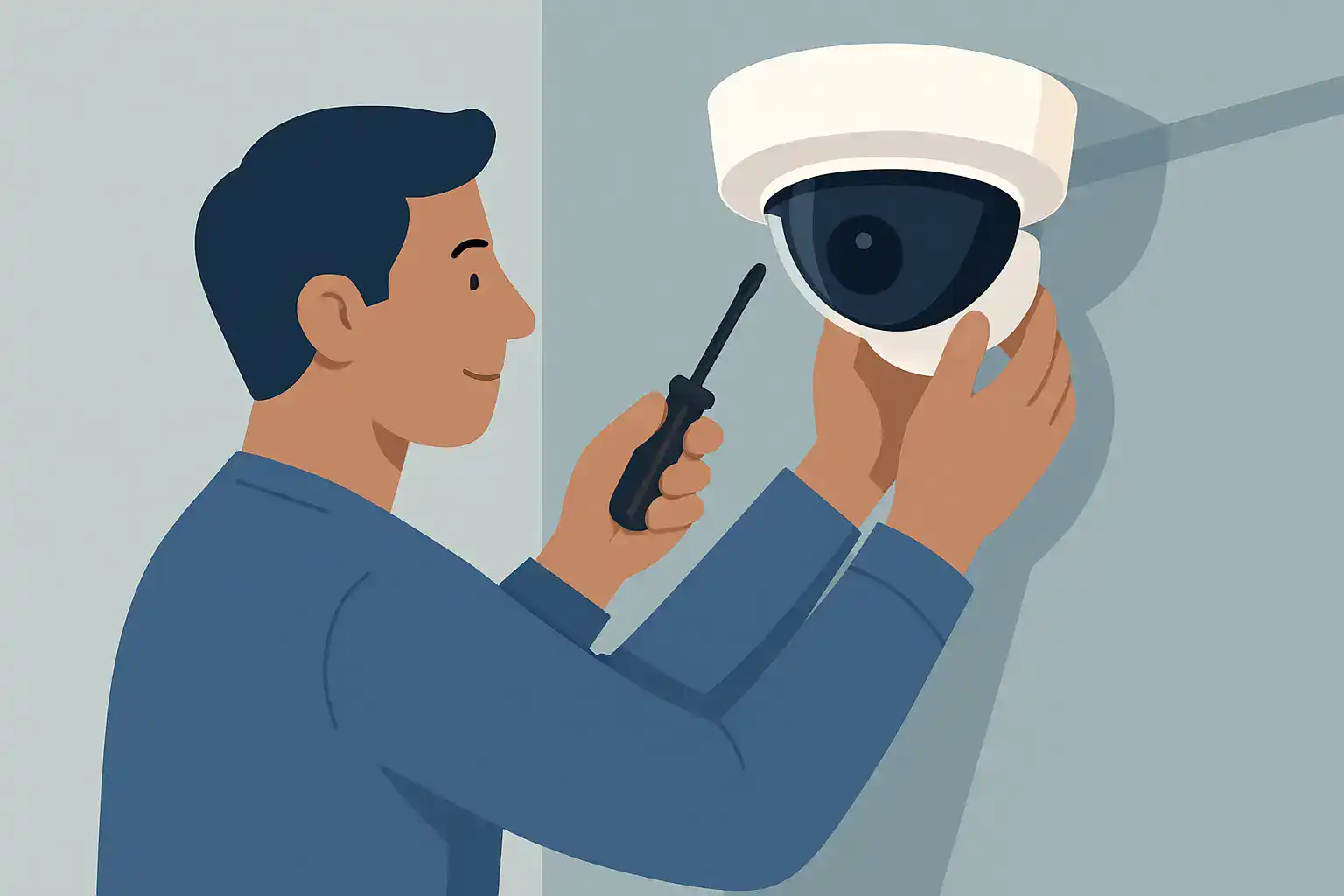
Most break-ins aren’t movie scenes—they’re fast decisions made by someone scanning for the easiest target. The job of a dummy security camera is to make your home look like the harder option. But there’s a catch: if it’s installed like a prop, it gets treated like a prop.
This guide shows you how to install dummy security cameras so they read as “active surveillance” from the street, the driveway, and the side gate—without wasting money, drilling the wrong holes, or creating blind spots.
A dummy camera can’t record faces, capture license plates, or send alerts. What it can do is influence behavior—especially when it’s placed where a would-be intruder must notice it before they reach a door or window.
That trade-off matters. If you want evidence after the fact, you need a real system. If your goal is a visible deterrent on a budget (or a supplemental layer that makes your home look monitored), a dummy camera can pull its weight.
The key is credibility: believable placement, solid mounting, realistic details, and a setup that doesn’t scream “fake.”
Not all dummy cameras create the same psychological effect. The best style depends on your property and your goals.
A “bullet” style (the classic rectangular camera on a swivel bracket) looks right on eaves, garages, and exterior walls. A “dome” style tends to look more professional in covered entries and porches—plus, domes make it harder for someone to tell which direction the lens is facing, which adds pressure.
If your dummy has a blinking LED, use it carefully. Some people love the obvious “armed” vibe. Others recognize that many real modern cameras don’t blink. In neighborhoods where people know security tech, a constant red blink can backfire. If your unit lets you disable the LED, consider doing that and focusing on placement and signage instead.
If you want a dummy camera to deter, it has to be seen early and often—without being easy to tamper with.
A person sizing up a house typically evaluates three things: the front approach, the driveway/garage area, and the easiest side access route to the backyard. Those are your priority zones.
Place one camera where it’s visible from the street as someone walks up, and another that covers the driveway or garage door area. If you only install one, put it where it’s unmissable during the approach to your main entry.
There’s a sweet spot: typically 8–10 feet high on a single-story home, or on a second-story corner that still looks reachable by the system (not “floating in space”). Too low and it’s easy to grab, twist, or smash. Too high and it looks like it can’t capture anything useful—which makes it feel fake.
Pointing matters, even for a dummy. Angling a camera straight down at the doormat looks staged. Instead, aim it to “watch” the approach path: the walkway, the driveway line, or the gate entrance.
Also avoid aiming directly into the sun for long periods (like a west-facing wall with full afternoon glare). Real installers think about that, and so do experienced prowlers.
Walk your property the way a stranger would. Where are the hiding spots? Which window is shielded by shrubs? Which side yard is invisible from the street? Those are areas where real lighting and physical security matter most—and where a dummy camera should be used as an extra layer, not your only layer.
Most dummy cameras mount with basic hardware, but the install goes smoother if you’re prepared.
You’ll typically need a drill/driver, a small drill bit for pilot holes, exterior-rated screws and anchors (especially for stucco, brick, or masonry), a pencil, and a step ladder. If your camera has a fake cable, grab cable clips or small outdoor-rated staples so you can route it neatly.
A small tube of exterior silicone sealant is smart if you’re drilling into siding or trim. You’re not just mounting a camera—you’re protecting your home from water intrusion.
You don’t need to be a contractor to get this right. You do need to install it like you mean it.
Hold the camera bracket against the wall where you want it. Step back to street level and look at it from multiple angles—front walkway, driveway, and side yard.
Ask two questions: “Will someone notice this?” and “Does it look like it’s watching something valuable?” If the answer to either is no, adjust now—because moving it later usually means extra holes.
Use the bracket as a template and mark your holes with a pencil. Drill pilot holes first. This reduces the chance of splitting trim, cracking siding, or stripping screws.
If you’re mounting into stucco, brick, or masonry, use the correct bit and anchors. A dummy camera that wobbles in the wind screams “cheap” in a way you don’t want.
Attach the bracket firmly. Test it by applying a little pressure side-to-side and downward. It shouldn’t twist or rock.
If your camera has a ball joint or swivel, tighten it enough that it holds its aim through rain, heat, and vibration from doors closing.
A visible wire or conduit line makes a dummy camera look more legitimate—because many real systems have a power line, an Ethernet run, or both.
Route the included cable along a corner seam, under an eave, or down a trim line. Secure it with clips so it doesn’t hang loose. If the cable ends nowhere, don’t leave it dangling in mid-air. Tuck it into a small junction box, behind a downspout line, or into the edge of soffit where it appears to enter the structure.
Angle the camera to cover approach paths, not empty sky. A good visual is about a 15–30° downward tilt in most locations.
Then tighten every adjustment point. If the camera’s “lens” is obviously centered, consider slightly offsetting the aim like a real camera would be—toward the driveway line or front steps.
If you drilled into exterior trim or siding, add a small bead of silicone where needed to block water. If screws are exposed and easy to remove, consider using security screws (the kind that require a specialty bit) for a more serious look.
Dummy cameras do their best work when your home looks watched 24/7. After dark, stand at the street and see whether the camera is visible under porch light or ambient street lighting.
If it disappears completely at night, improve lighting. Motion-activated lights are one of the most effective “force multipliers” you can add, because they create instant attention when someone approaches.
Dummy cameras fail for predictable reasons.
The biggest mistake is placing them where no one sees them until they’re already at the door. If an intruder notices your camera only after they’ve reached your entry, you’ve lost the deterrence window.
Another common mistake is installing a camera in a spot that makes no sense—like pointed at a blank wall, mounted crooked, or aimed directly into a neighbor’s yard. Believability is everything.
Finally, don’t overdo it. Four fake cameras clustered on the front porch looks like panic, not protection. Two well-placed units often look more realistic than a dozen.
Dummy cameras work best as part of a broader signal: “This home is prepared.” A few practical layers can elevate that message without turning your house into a fortress.
A simple yard sign or window decal that indicates surveillance can help—especially when it’s placed where someone approaches, not hidden behind a bush. Consistent lighting, trimmed landscaping (so there’s less cover), and strong door hardware send the same message.
If you want to keep it affordable and straightforward, pairing a visible dummy camera with a loud door/window alarm can be an effective one-two punch: the camera discourages the attempt, and the alarm punishes the attempt.
If you’re building a security setup over time, you can start with dummy cameras now and later add real coverage at your highest-risk entry points.
Sometimes a dummy camera isn’t the right call. If you’ve had repeated incidents, package theft, vandalism, or you need evidence for law enforcement or property management, real recording is worth it.
Also consider real cameras if your property has long approach paths, shared driveways, or you can’t position a dummy camera where it will be seen clearly. In those cases, deterrence alone may not be enough.
If you’re looking to add dummy cameras or other practical safety tools without overcomplicating your plan, Elite Warrior Defense carries a range of home security and personal defense options designed to be approachable and budget-friendly.
The closing thought to keep in mind: a dummy camera isn’t about pretending—it’s about projecting readiness. Install it like a real system, back it up with light and sound, and you’ll make your home a much less attractive target.



YOU’RE IN!
Use this code on every order
🎉
Here’s Your Code!
Use it now an on every future order.
YOUR DISCOUNT CODE
We also sent this code to your email for safekeeping.
EXCLUSIVE OFFER
Every order – not just your first!
Unlock Your Discount Instantly
Enter your email below and your personal 15% discount code appears right here – no need to check your inbox.
🔒 We respect your privacy. Unsubscribe anytime.