
You are holding a leash, a waste bag, and your phone is somewhere you cannot reach fast. That is the reality of most dog walks – your hands are busy and your attention is split. If something goes sideways, you do not get a clean, two-handed “self-defense stance.” You get a half-second decision while your dog is reacting.
That is why choosing self defense tools for dog walkers is not about owning the “strongest” gadget. It is about what you can access with one hand, under stress, without endangering your dog, your neighbors, or yourself.
Most people picture a human attacker. That can happen, but dog walkers deal with a wider range of real-world threats.
Loose dogs are a big one. Even a friendly dog can cause a fight if it rushes yours. Wildlife depends on where you live – coyotes, stray cats, even aggressive raccoons in some neighborhoods. Then there are human threats, which can look like harassment, stalking, or a sudden attempt to grab you or your dog.
Each situation asks for a different kind of response. A loud deterrent may be perfect for a person following too close. A distance tool may matter more for an off-leash dog charging from 20 feet away. And anything that creates a cloud or a blast has to be considered around your dog’s nose and eyes.
Dog-walk self-defense lives or dies on access. If a tool is buried in a backpack or clipped in a way that tangles with the leash, it is not a real tool – it is just something you own.
Start with three filters.
First: Can you activate it with one hand while maintaining leash control? Second: Will it work at the distance you realistically get on a sidewalk or trail? Third: Can you practice with it enough that you will not freeze?
If you carry more than one tool, they should not duplicate the same role. Think in layers: awareness and lighting, noise and attention, distance deterrence, then last-resort contact tools.
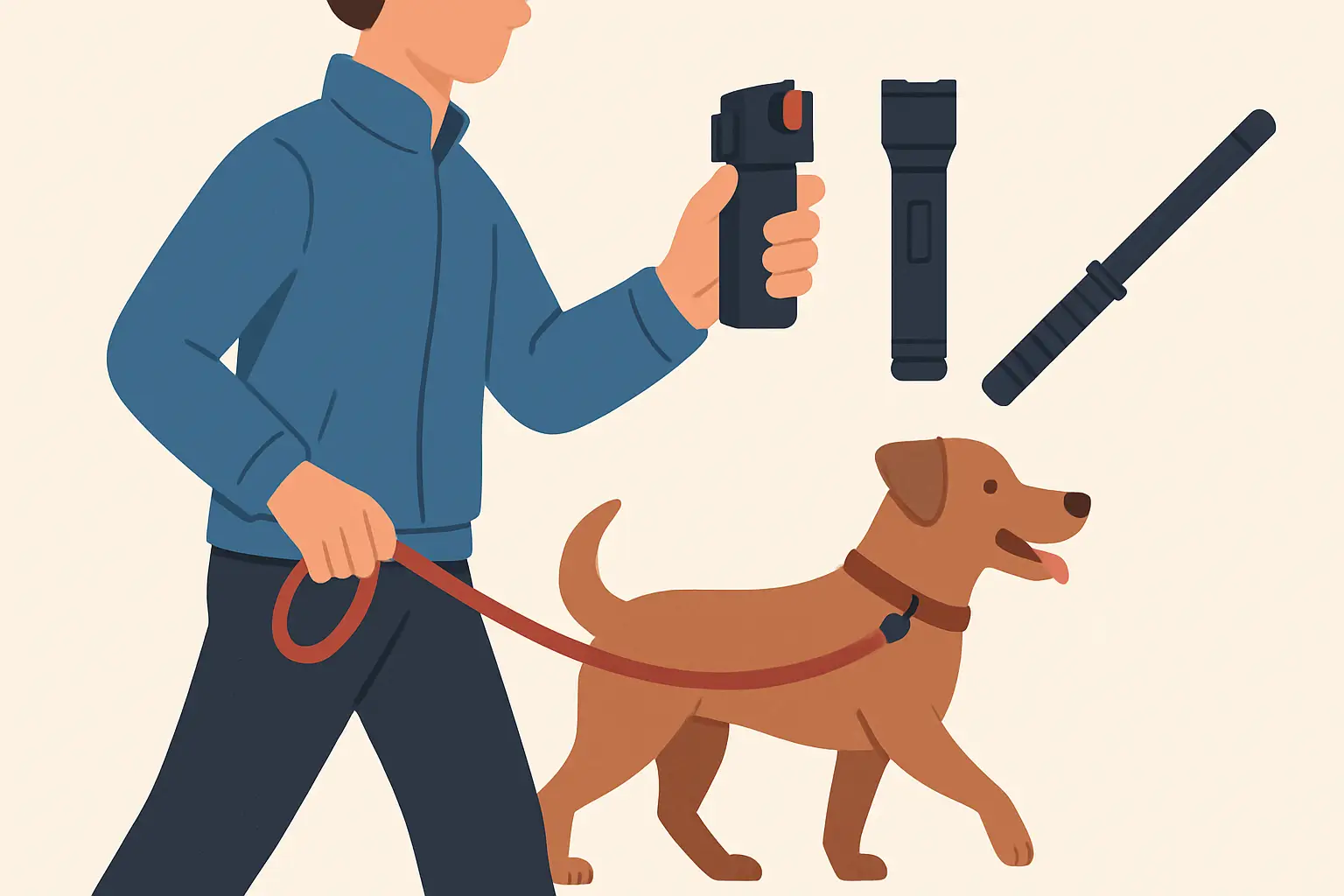
Pepper spray remains one of the most practical options for most adults because it can create space fast. For dog walkers, the best version is the one you can point and fire confidently without fumbling.
A few trade-offs matter here. Wind and blowback are real. If you spray upwind, you may get a face full of your own deterrent while your dog is right next to you. That is not hypothetical – it is a common failure.
You also need to think about your dog’s position. If your dog is in front of you or surging toward the threat, spraying in that direction can affect your pet too. In a loose-dog situation, you may not have a clean line.
Practical tips help. Keep the unit in the same place every walk. Many people choose a keychain style or a clip that stays on the same side as their dominant hand. Practice the motion of drawing it, flipping the safety, and aiming – with an inert trainer if you have one – until it is automatic.
Pepper spray is a strong choice when you want distance and you are in a more open area where you can create a clear lane. It is less ideal in tight spaces like apartment hallways, crowded sidewalks, or inside an elevator.
If your biggest worry is aggressive dogs or wildlife, an animal-labeled deterrent can be a smart layer. The goal is not “winning a fight,” it is stopping the approach and buying you time to leave.
The same wind and proximity issues apply, but your intent is different. You are trying to interrupt the animal’s forward movement, not engage in a prolonged confrontation. That means your best moment is often before contact, when the animal is still moving in and you have a few steps of space.
The key is readiness. If a loose dog is already on top of you, you may not have room to use any spray safely. That is when noise tools and physical barriers matter more.
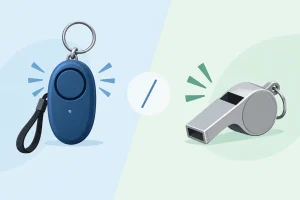
A personal safety alarm is one of the most underappreciated options for dog walkers because it does not require precision. Pull, press, or activate – and you get instant attention.
The benefit is psychological and practical. It can startle a threat, it can bring eyes to you, and it can flip the script when someone is testing boundaries. It also works with one hand and does not rely on aim.
Alarms are not magic. If you walk in a place where nobody is around, noise is less useful. But in neighborhoods, parks, and near businesses, a loud alarm can be the difference between being isolated and being seen.
A bright safety light is not just for finding poop bags. It is a self-defense tool because it prevents surprises.
For night walks, light does two jobs. It lets you scan ahead for movement, open gates, or a person lingering near a car. And it signals presence – you are not an easy target when you are alert and visible.
For dog walkers, a compact light you can hold while keeping the leash stable is the goal. A light also pairs well with every other tool on this list because it buys you those critical seconds earlier.
Stun devices can be effective in close range, but dog walking changes the equation. Close range is the place where leashes tangle, your dog may be within inches, and you may be moving.
A handheld stun gun can be a last-resort tool if someone is within arm’s reach and you have no path out. But it demands proximity and contact, and that is exactly what you want to avoid.
A stun baton adds reach and can double as a strong physical barrier. That reach can matter if you need to keep distance from an aggressive dog or a person trying to close in. The trade-off is carry comfort. A baton is not subtle, and it is not always convenient for casual walks.
If you choose a stun device, be honest about your routine. If you will not carry it consistently because it is bulky, it will not help you when you need it. And because laws vary by state and city, it is your responsibility to confirm what is legal where you walk.
Discreet tools like tactical pens and certain self-defense keychains are about access and simplicity. They are easy to keep on your body and they do not require batteries or spray conditions.
They also have limits. These tools are typically close-contact options, meaning you need an immediate threat. If your goal is to stop a situation before it reaches you, they are not your first line.
Where they shine is when your hands are already in a mess – leash wrapped, dog pulling, someone too close. A tool you can grip instantly without searching your bag gives you a fighting chance to break contact and get away.
Carrying five tools you never practice with is not being prepared. It is creating clutter.
A clean, realistic layer for many dog walkers is a light for visibility, a personal alarm for immediate attention, and a distance deterrent such as pepper spray or an animal repellent depending on your environment. Then you decide whether you want a close-contact backup, like a tactical pen, based on comfort and local rules.
Placement matters as much as the tool itself. If you always hold the leash in your left hand, your right hand is your access hand. Keep your primary tool on that side. If you switch hands often, you need a carry method that does not depend on perfect habits.
Tools work best when your behavior supports them.
Keep your head up and scan ahead every 10 to 15 seconds. Avoid getting trapped between parked cars and fences if you can choose a clearer route. If you feel uneasy, cross the street early instead of waiting for the “proof” that something is wrong.
Also train your dog for safety. A solid “heel” and “leave it” reduce chaos in moments that count. If your dog lunges at other dogs, you are more likely to be pulled off balance right when you need control.
Practice your draw in your home. Not once. Repetition is what turns panic into action. It should feel as normal as grabbing your keys.
If you want a one-stop place to pick up practical self-defense gear like pepper sprays, dog repellents, safety lights, and alarms without overpaying, Elite Warrior Defense at https://elitewarriordefense.com/ is built around exactly that kind of everyday readiness.
If you walk at sunrise in a quiet suburb, a bright light and an alarm may cover most of your risk, with a spray tool for the rare loose-dog incident. If you walk in a dense city at night, you may prioritize an alarm and a spray you can deploy in tight spaces, plus a discreet backup tool on your person. If you walk trails, your focus may shift toward animal deterrence, visibility, and a plan for what you do when you see wildlife – not when it is already close.
The best choice is the one you will actually carry, can actually use with one hand, and have actually practiced. Confidence is not a vibe. It is a system you can run when your leash hand is full and your heart rate spikes.
Walk your dog with your guard up, not your stress up. The goal is a safer routine you can repeat every day.

YOU’RE IN!
Use this code on every order
🎉
Here’s Your Code!
Use it now an on every future order.
YOUR DISCOUNT CODE
We also sent this code to your email for safekeeping.
EXCLUSIVE OFFER
Every order – not just your first!
Unlock Your Discount Instantly
Enter your email below and your personal 15% discount code appears right here – no need to check your inbox.
🔒 We respect your privacy. Unsubscribe anytime.